Most organisations have a rough rule for contracts: keep them "for a long time". That rule fails in both directions. Some files disappear when a shared drive is tidied up, just before a claim arrives. Others sit untouched for fifteen years, full of names, phone numbers and identity-check results that nobody needed after the contract ended.
A retention schedule replaces the rough rule with a short table of decisions: which records you keep, from which event the clock starts, for how long and why, who can pause deletion, and how deletion is carried out and recorded. For electronically signed contracts there is an extra layer, because the contract is only half the record. The signing evidence matters just as much, and it carries personal data of its own.
This guide shows how to build that schedule. The periods themselves depend on your countries, sector and contract types, so treat every number here as an example to confirm with counsel, not as a recommendation.
Know what a signed contract record actually contains
Before deciding how long to keep something, list what "something" is. For an electronically signed agreement, the record usually has several parts, and they are not equally sensitive.
| Component | Why it matters later | Personal data? |
|---|---|---|
| Final signed file | The terms the parties agreed to. | Names, titles, sometimes addresses. |
| Evidence record and audit trail | Who signed, when, how they were authenticated, what happened in between. | Email addresses, phone numbers, IP addresses, device details. |
| Fingerprint and timestamp | Proof that the file has not changed since signing. | Usually none on their own. |
| Identity-verification outcome | Supports the claim that the signer was who they said. | Yes, and often the most sensitive part. |
| Amendments, renewals, notices | The contract as it stands today, not as first signed. | Similar to the original. |
| Internal approvals | Who authorised sending it. | Staff names. |
The table makes one point obvious: the parts you most need in a dispute, the audit trail and the fingerprint, are useless without the file they describe, so the schedule should keep them together and delete them together.
Start the clock at the right event
The most common drafting mistake is counting the retention period from the signature date. Claims under a contract usually arise while it is running or after it ends, so the useful trigger is normally the end of the relationship: expiry, termination, final payment or final delivery, whichever is latest.
Limitation periods are the usual anchor for the length. In England and Wales, for example, section 5 of the Limitation Act 1980 provides that an action founded on simple contract may not be brought after six years from the date the cause of action accrued, and section 8 sets twelve years for an action upon a specialty. Other countries use different periods and different starting points, and sector rules on tax, employment or financial records may require longer. Many organisations add a buffer to the limitation period because the date a cause of action accrues can be later than the contract end date.
Keep the end dates where the schedule can use them. If your contracts carry expiry and renewal dates in your signing platform, as wsign's renewals and expiry tracking does, the trigger event is already recorded rather than buried in a PDF.
Balance retention against storage limitation
Keeping everything forever is not a safe default where data protection law applies. The EU's General Data Protection Regulation sets out the storage limitation principle in Article 5(1)(e): personal data must be kept in a form that permits identification of data subjects for no longer than is necessary for the purposes of processing. Article 5(2) adds accountability, so the controller must be able to demonstrate compliance, which in practice means writing down the reason behind each period.
The same Regulation recognises the reasons contracts are kept. Article 17(3) lists situations where the right to erasure does not apply, including where processing is needed to comply with a legal obligation under Union or Member State law (point (b)) and for the establishment, exercise or defence of legal claims (point (e)). And Article 30(1)(f) expects the record of processing activities to include, where possible, the envisaged time limits for erasure of different categories of data. A retention schedule is the natural place to keep those limits.
The practical outcome is a schedule that justifies length with a named reason, such as a limitation period or a statutory record-keeping duty, and that trims what is not needed. You might, for instance, keep the signed file and core evidence for the full period while minimising more sensitive identity-check details earlier, if your legal advice supports that.
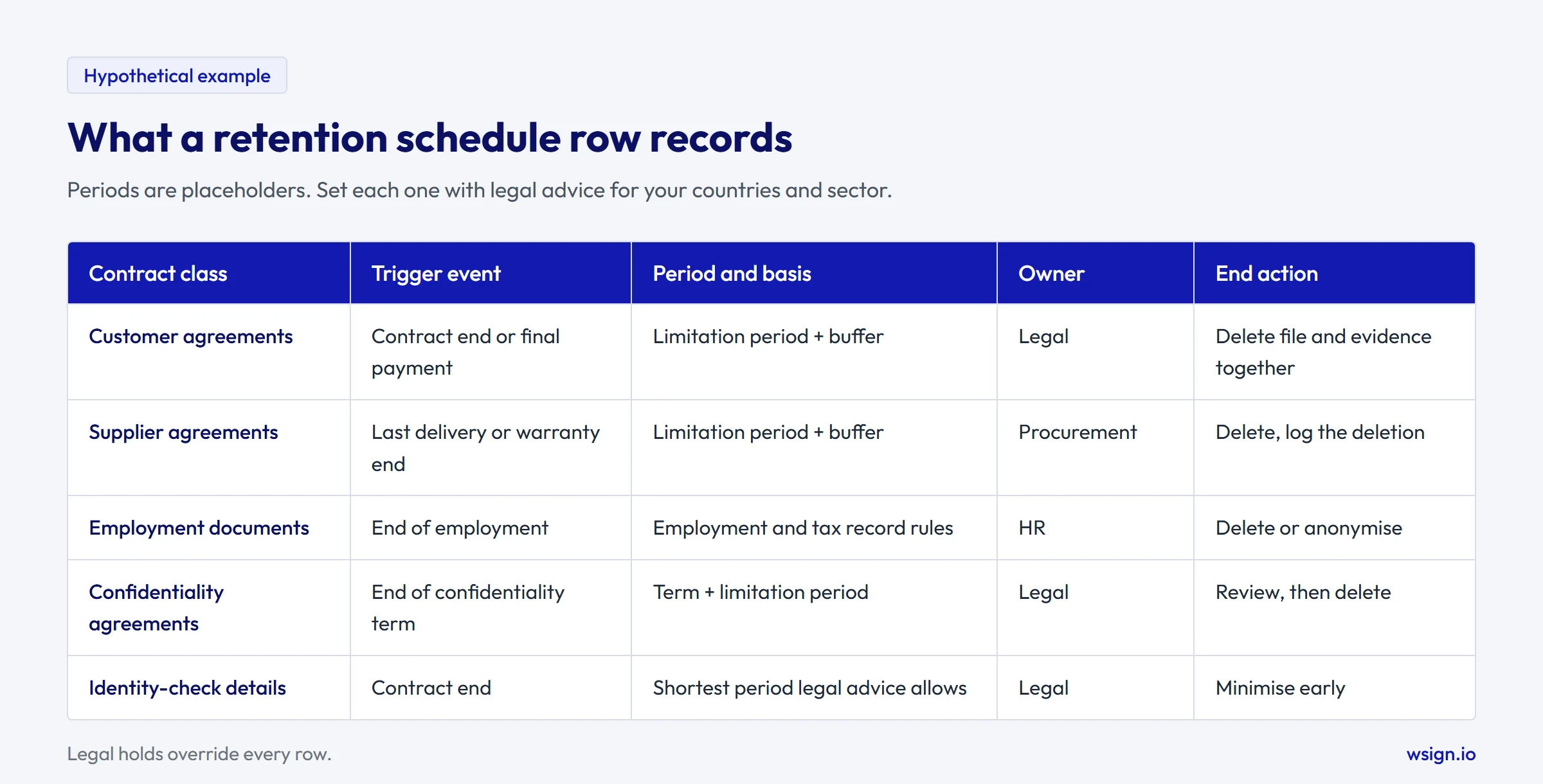
Build the schedule in five passes
- Group contracts into classes. Customer agreements, supplier agreements, employment documents, confidentiality agreements, property and leases. A class is useful when its members share a trigger event and a reason for keeping them.
- Name the trigger for each class. End of contract, end of employment, final payment, or the date a guarantee lapses.
- Record the period and its basis. Write the number and the reason side by side: "limitation period plus buffer", "tax record rule", "until warranty ends". A period without a basis is the first thing an auditor or regulator will question.
- Assign an owner. Someone in legal, finance or HR who confirms the class is still correct each year and approves exceptions.
- Define the end action. Delete, anonymise, or review. "Review" is acceptable for a few high-value classes, but if everything is marked review, nothing will ever be deleted.
Keep electronic records usable for the whole period
A record you cannot open or rely on at year nine has not really been retained. The US ESIGN Act states the test well: under 15 U.S.C. §7001(d)(1), a legal requirement to retain a contract or record can be met by an electronic record that accurately reflects the information and remains accessible to those entitled to it, in a form capable of being accurately reproduced for later reference.
In practice that means three habits. Store the final file in a durable format such as PDF together with its evidence record. Keep the material that proves integrity, the fingerprint and a trusted timestamp, alongside it. And keep a way to check the document independently: with wsign, the verification number lets anyone confirm the fingerprint on the public verification page. Our guide to electronic contract archiving covers storage formats and locations in more depth.
Legal holds: the switch that stops deletion
A schedule needs an override. When litigation, an investigation or an audit is reasonably anticipated, relevant records must be preserved even if their period has run out. A workable hold process answers four questions in writing:
- Who can place a hold, usually legal counsel, and on what kinds of trigger.
- How the hold is applied, so that automated deletion actually skips the affected records, including copies held by other teams.
- How it is documented: the matter, the scope, the date and the person who placed it.
- How it is released, because a hold that is never lifted quietly becomes indefinite retention.
Delete deliberately, and keep a record that you did
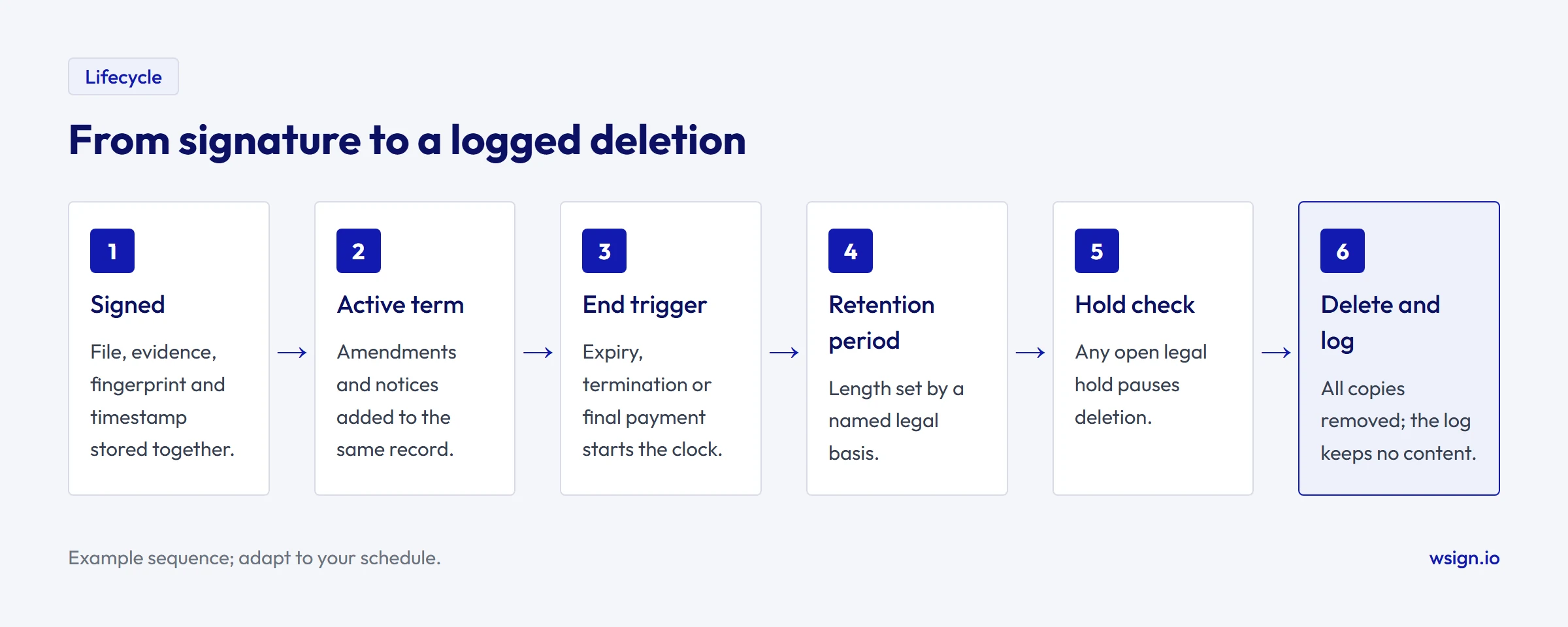
Deletion is a process, not a click. A signed contract tends to exist in several places: the signing platform, a document system, email attachments, downloaded copies and backups. Your procedure should say which copies are deleted actively and which expire through the normal backup rotation.
Then record the deletion itself: which class, which identifiers, when, under which rule and with whose approval. That log should not contain the deleted content; its job is to show that deletion followed the schedule, which supports the accountability principle without defeating the point of deleting.
Frequently asked questions
Should the evidence record be kept as long as the contract?
Generally yes. The evidence shows how the contract was signed, and in a dispute it is often what the other side challenges. Deleting it earlier than the file weakens the file.
Does a retention schedule conflict with a deletion request from a signer?
Not necessarily. Under the GDPR, erasure does not apply where processing is needed to comply with a legal obligation or for legal claims. Assess each request on its facts and record the reasoning.
Is the signature date or the end date the better trigger?
For most commercial contracts the end of the relationship is the better trigger, because claims usually arise during or after performance.
How often should the schedule be reviewed?
At least yearly, and whenever you enter a new country, sector or contract type.
wsign keeps each signed document with its evidence file, fingerprint and expiry dates in one place, which makes a retention schedule easier to apply. Create an account to see how your records are organised.
This article is general information, not legal advice.