Schools and universities do not sign documents evenly through the year. They sign them in waves: enrolment week, the start of term, the trip season, internship placements, contract renewals for staff. In each wave the same office asks hundreds of people for the same signature by the same date, and the paper version of that exercise is a pile of forms, half of them missing a page.
Education also has a complication most businesses do not face: many of the people whose lives the documents affect are minors, so the person who signs is often not the person the document is about. Getting that relationship right matters more than any feature of the signing tool.
This article goes through the main document families in education, who should sign each one, and how to run the signing so that the record holds up when a parent, a regulator or an accreditation body asks questions later.
Where signatures pile up in an academic year
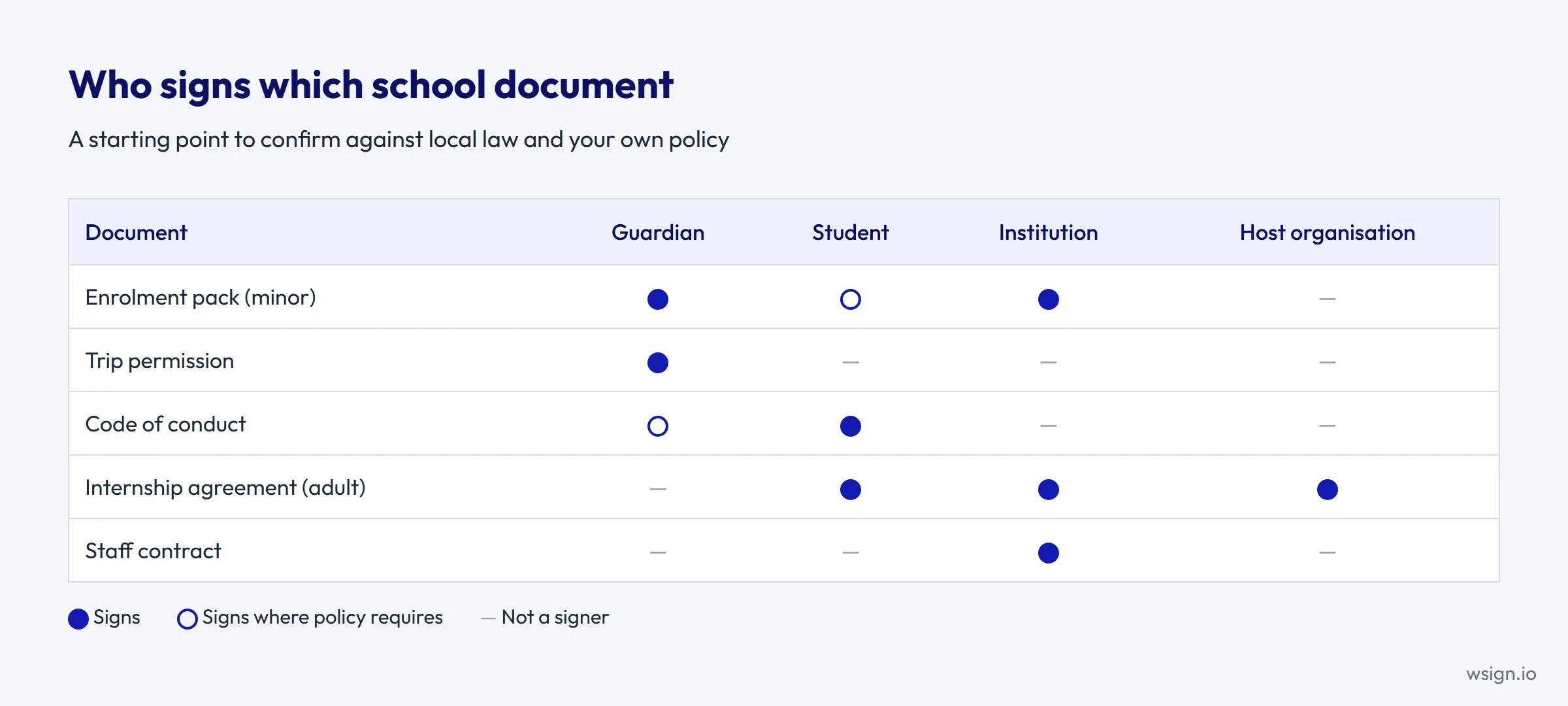
| Document | Typical signers | When |
|---|---|---|
| Enrolment or admission form | Parent or guardian; the student when adult | Before the term |
| Data, photo and media consents | Parent or guardian, or adult student | Enrolment, then on change |
| Trip and activity permission | Parent or guardian | Days or weeks before each activity |
| Code of conduct or acceptable-use acknowledgement | Student, often with a guardian | Start of year |
| Internship or placement agreement | Student, institution, host organisation | Before the placement starts |
| Staff contract and renewal | Employee and authorised signatory | Hiring and renewal dates |
Two patterns stand out. Most documents are sent to many people at once, and many need more than one signer. Plan your setup around those two facts rather than around individual forms.
Enrolment: one pack per student, sent to the right contact
An enrolment pack usually combines the admission form, a fee or payment acknowledgement, emergency contacts, medical notes and several consents. Build it once with the contract editor or upload the form you already use through PDF import, then send one request per student.
The decision that matters most is where the request goes. Send it to the guardian contact already held in your records, not to an address typed in by the student during registration. A request routed to the wrong inbox produces a valid-looking signature from the wrong person, which is worse than no signature at all.
Decide in advance whether one guardian is enough or whether both must sign, for example where parents are separated and both hold parental responsibility. If both must sign, add them as two signers. If the order does not matter, let them sign in parallel so neither waits for the other.
Minors and guardian signatures
Who may sign for a child, and from what age a young person may sign alone, is a question of local law and of your institution's own policy. It differs between countries and sometimes between types of document. Take advice from counsel in your jurisdiction and write the answer down for each document type.
Two sourced examples show how specific these rules can be:
- In the United States, the FERPA regulations require "a signed and dated written consent" from the parent or eligible student before an institution discloses personally identifiable information from education records, subject to listed exceptions, and they accept a record and signature in electronic form that identifies and authenticates the person and indicates their approval (34 CFR 99.30, summarised by the US Department of Education).
- In the EU, Article 8(1) of the General Data Protection Regulation sets 16 as the age at which a child can consent alone to online services offered directly to children, lets member states lower that age to no less than 13, and below it requires consent "given or authorised by the holder of parental responsibility" (Regulation (EU) 2016/679).
Neither rule covers every school form, and both show why a single "student signs" setting is not enough. In practice, model the guardian as the main signer, and add the student as a second signer where your policy asks for the student's own acknowledgement, such as a code of conduct.
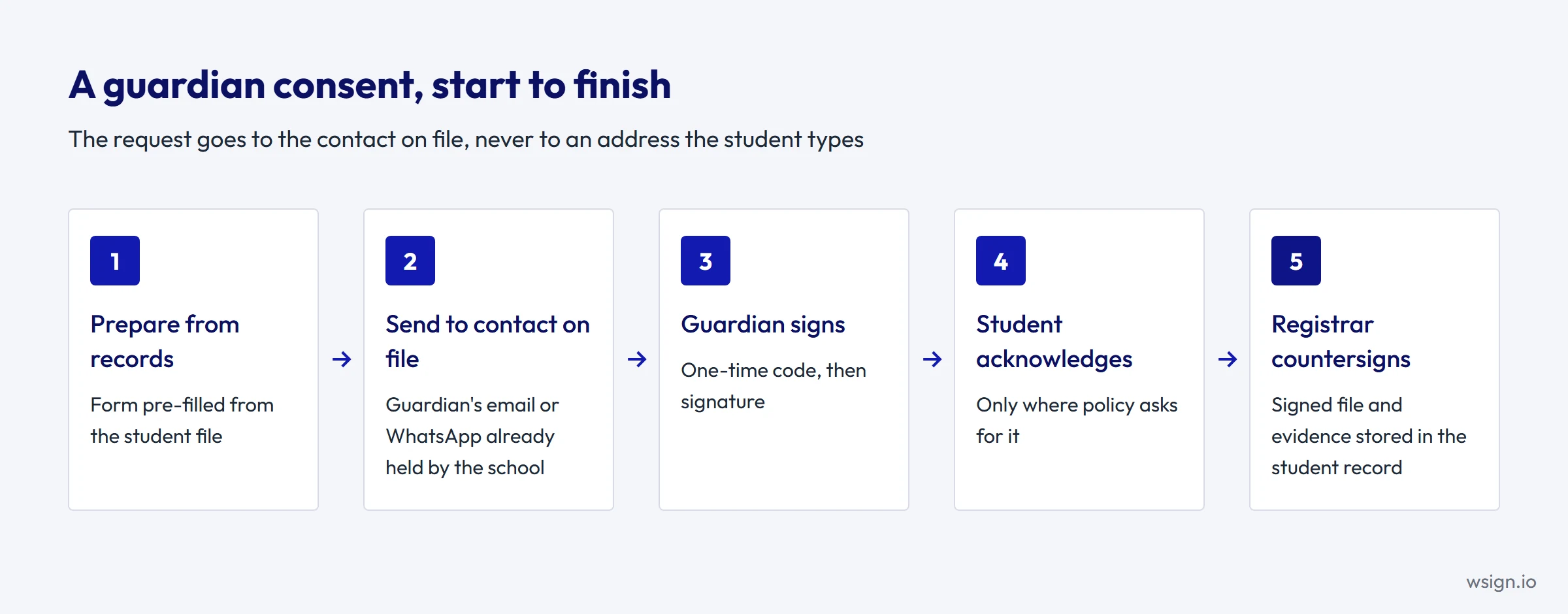
When the child reaches the age at which they sign for themselves, do not silently rely on old guardian consents for new purposes. Ask the student for fresh consent where the law or your policy requires it.
Trip and activity permissions
Permission slips are the classic lost-paper document. Electronic signing fixes the obvious problem, but the real gain is visibility. With bulk sending, one request per student goes out from the same document, and your dashboard shows who has signed, who has opened the message, and who has not seen it yet.
- Set the expiry before the activity date, with enough margin to chase the last few families by phone.
- Turn on reminders so staff do not spend the week sending individual messages.
- Treat silence as "no". An unsigned request is not consent, however close the deadline.
- Put the specifics in the document: dates, transport, cost, medical arrangements. A guardian consents to what the document says, not to what was in a separate newsletter.
Internship and placement agreements
An internship agreement usually has three parties: the student, the institution and the host organisation. Each one commits to something different, such as learning objectives, supervision and insurance, so each must see and sign the same final version.
A sensible order is host organisation first, then student, then the institution's placement office, which checks that the signed version matches its requirements before countersigning. Multiple signers with a signing order enforces that sequence, and every party receives the completed file with one evidence record. Keep insurance certificates and the training plan inside the same PDF, so that the signature covers them too.
Staff contracts and renewals
Teaching and administrative contracts often run by academic year, so dozens expire on the same date. Renewal reminders help the HR team start conversations early instead of discovering expired contracts in September; see contract renewals and the wider HR use case. As with any employer, the institution's signature should come from a person authorised to bind it, which the article on who can sign for a company explains.
Protecting student records around signing
Signed school documents contain children's personal data, medical information and family details. Four habits keep that data safer:
- Collect what the document needs, nothing more. A trip slip does not need a national ID number.
- Limit who can send and view. Not every teacher needs access to every enrolment pack. Use team roles and an internal review workflow for documents that leave the institution.
- Protect staff accounts with two-step verification through an authenticator app.
- Apply a retention schedule so that consents are kept for as long as your rules require, and no longer.
Frequently asked questions
Can a parent sign school forms on a phone?
Yes. Signing works in a mobile browser without installing anything, and the one-time code can arrive by email or WhatsApp, whichever the family uses.
What if two guardians disagree?
If your policy requires both guardians, send the document to both. If one signs and the other declines, the request does not complete, and the decision returns to your staff and your policy, not to the software.
Should we verify a guardian's identity?
For routine slips, sending the request to the contact on file with a one-time code is usually proportionate. For high-stakes documents, such as authority to collect a child or medical decisions, consider identity verification and take advice on what your jurisdiction expects.
Can an adult student sign their own internship agreement?
Often yes, but the age at which a student signs alone, and for which documents, depends on local law and institutional policy. Confirm it with counsel and record the rule.
To try it with one enrolment pack or one internship agreement, open a wsign account and import the form you already use.
This article is general information, not legal advice.