When a contract arrives signed by "Head of Partnerships" on behalf of a company, two separate questions are hiding behind that signature. The first is whether the named person really signed. The second is whether that person had the power to commit the company at all. A good electronic signing process answers the first question very well. The second depends on the company's own rules and on the law where it is registered.
Businesses often check the first and assume the second. That assumption is usually harmless for routine purchases and occasionally very expensive for large ones: when a counterparty later disowns a signed agreement because the signer lacked authority, what you hold is the start of a dispute rather than a dependable contract.
This article explains where signing authority comes from, uses one sourced legal example to show how specific the rules can be, and sets out a practical check you can run before relying on a company's signature, and before your own company signs.
Two questions: who signed, and could they bind the company?
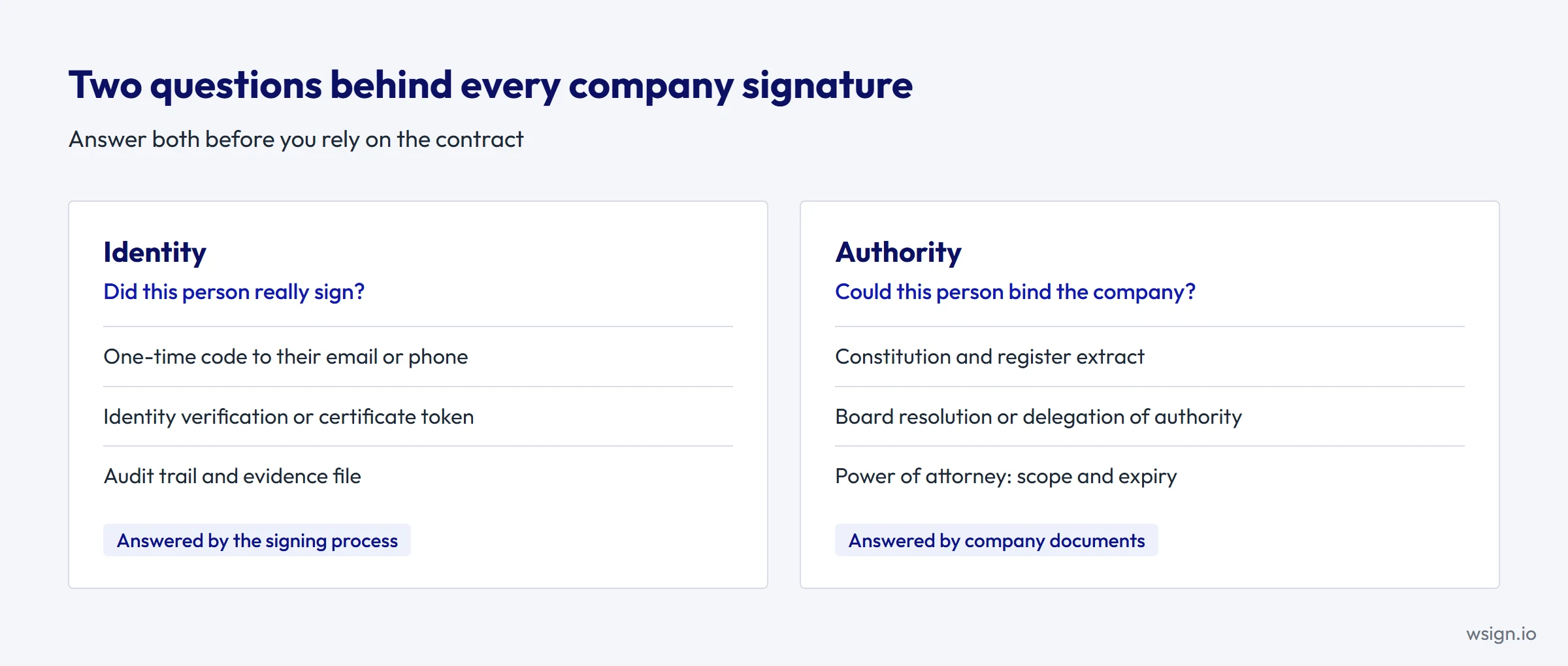
Identity is about the person: the one-time code reached their email or phone, an identity check matched their document, or a certificate token issued by a licensed provider tied the signature to them. The audit trail and evidence file record all of this. For a closer look at identity levels, see electronic identity verification.
Authority is about the role: whether the company's constitution, its board, or a power of attorney allowed this person to sign this document for the company. No signing platform can decide that for you, because the answer lives in the company's records, not in the signature.
Where signing authority comes from
| Source | What to ask for | What it shows | Watch for |
|---|---|---|---|
| Law and the company's constitution | Register extract, articles of association | Which officers can represent the company, alone or jointly | Joint-signature requirements; restrictions in the articles |
| Board resolution | Certified copy of the resolution | Approval of a specific transaction and who signs it | Date, quorum, the exact document it covers |
| Internal delegation of authority | A letter confirming the signer's limit | Which managers may sign which documents, up to what value | Internal rules are not always visible to outsiders |
| Power of attorney | The power of attorney itself | Authority given to a named person, for stated acts | Scope, expiry, revocation, any required formalities |
Many legal systems also protect a counterparty who reasonably relied on how authority appeared from the outside, but the conditions vary widely between countries. Do not plan your process around that protection; plan it around evidence you have actually seen.
A sourced example: how companies execute documents in England and Wales
The UK Companies Act 2006 shows how precise these rules can be. It is one example, not a model for other countries.
- Contracts. Under section 43, a company can make a contract in writing under its common seal, or through a person "acting under its authority, express or implied".
- Executing documents. Under section 44, a company executes a document either by affixing its common seal or by signature: by two authorised signatories, or by one director in the presence of a witness who attests the signature. Every director is an authorised signatory, and so is the company secretary of a private company that has one, or of a public company. A document signed that way and expressed to be executed by the company has the same effect as one executed under the common seal.
- Protection for purchasers. Section 44 also lets a purchaser in good faith for valuable consideration treat a document that appears to be signed in that way as duly executed.
- The seal is optional. Section 45 states that a company "may have a common seal, but need not have one", and if it has one, its name must be engraved on it in legible characters.
These provisions cover England and Wales and Northern Ireland. Other jurisdictions, including those in the Gulf and the wider MENA region, have their own rules on who represents a company and how documents are executed, and some require particular formalities for certain documents. Check the rules for the counterparty's place of registration with local counsel when the transaction matters.
For UK companies, the public register is a quick starting point: GOV.UK states that you can get information about a company free of charge from Companies House, including its current and resigned officers.
Checking authority before you rely on a signature
Scale the check to the value and risk of the document. A routine purchase order does not need a board resolution; a five-year supply agreement or a share purchase might. A practical sequence looks like this:
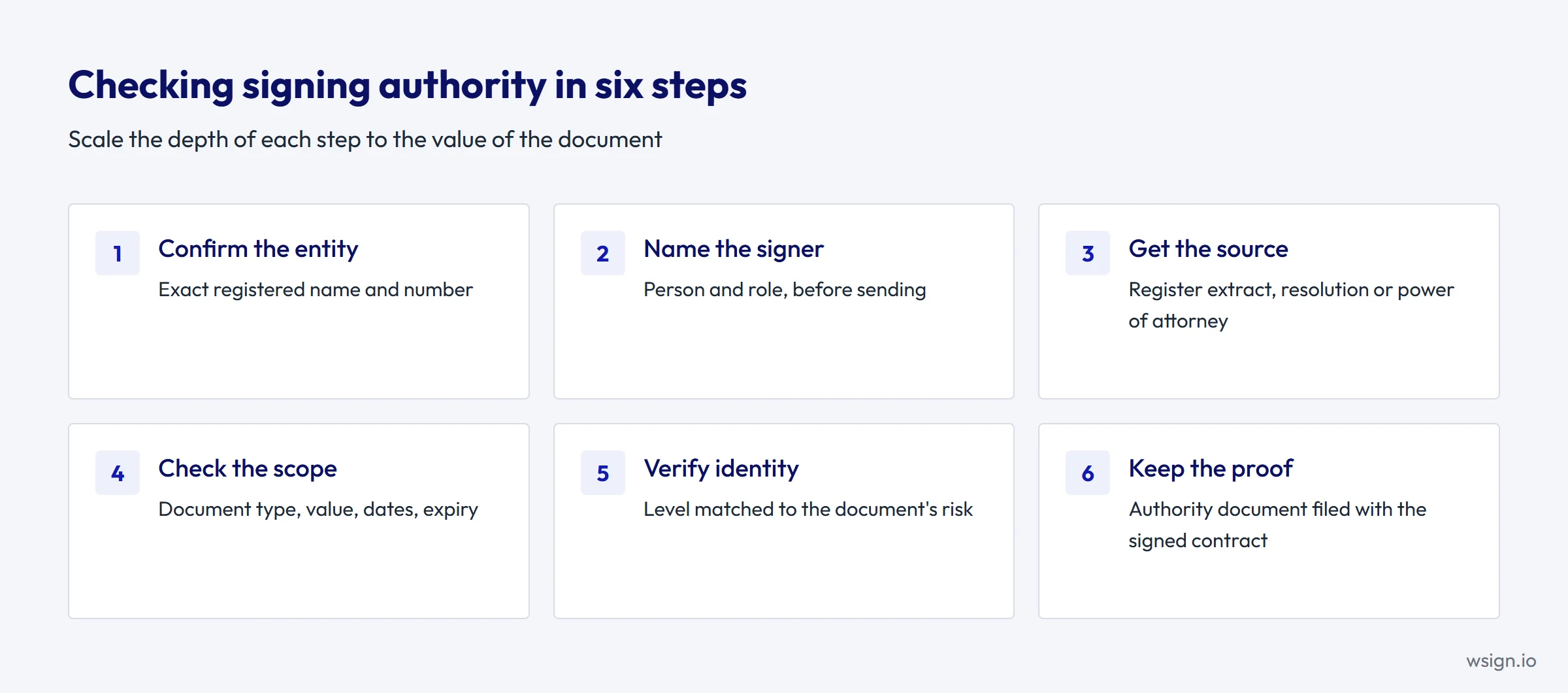
- Confirm the legal entity. Use the exact registered name and registration number in the contract, not a trading name. Many disputes start with a contract signed by the wrong company in a group.
- Name the signer and their role before you send the document, so the signing request goes to that person and not to whoever forwards it.
- Obtain the source of authority: a register extract, a resolution, or a power of attorney, depending on the table above.
- Check the scope. Does the authority cover this type of document, this value and this date? Has the power of attorney expired?
- Verify the signer's identity at a level that matches the document. For high-value agreements, identity verification or a certificate token adds weight; see the guide to one-time code verification for the lighter options.
- Keep the evidence with the contract. Attach the resolution or power of attorney to the PDF before sending, or store it in the same file as the signed document and its evidence record.
Board resolutions and powers of attorney: what good ones say
A resolution you can rely on
A useful board resolution names the transaction or document, the person authorised to sign it, any value or term limits, and the date. A vague resolution that authorises "any director to sign any agreement" may be valid, but it tells you little about whether this particular deal was approved. Where the board itself signs electronically, each member's signature and its evidence sit in one record; the article on e-signatures for nonprofits describes how boards sign written resolutions remotely.
A power of attorney you can rely on
Read the scope rather than the title. Check that it names the attorney, covers the act in question, has not expired, and has not been revoked. Some countries require powers of attorney to be notarised, legalised or registered before they can be used for particular acts, so take local advice when the document will be filed with an authority.
Your own side: deciding who signs for your company
The same discipline applies inward. Write a short delegation of authority that says who may sign which documents and up to what value, then make the signing setup match it:
- Route documents through an internal review workflow so legal or finance approve before an authorised signatory signs.
- Where your rules require two signatories, configure two signers in a fixed order with multiple signers.
- Limit use of the company's digital seal to the people entitled to apply it. A seal identifies the company in the evidence, but it does not create authority on its own: who applied it, and under what mandate, still matters.
- Protect the accounts of authorised signatories with two-step verification.
Red flags worth a pause
- The signer's email domain does not match the company, or changes halfway through the deal.
- A junior title signs a high-value agreement with no supporting document.
- The counterparty asks to change the named signatory at the last minute, with urgency.
- The power of attorney is an unreadable scan with no date.
- The registered name in the contract differs from the name on the register.
None of these proves fraud. Each one is a reason to ask for the source of authority before you countersign.
Frequently asked questions
Does an electronic signature prove the signer had authority?
No. It shows who signed and how they were verified. Authority comes from the company's constitution, its board, or a power of attorney, and must be checked separately.
Does a company need a seal to sign contracts?
It depends on the country. In England and Wales, section 45 of the Companies Act 2006 makes a common seal optional. Other jurisdictions and some counterparties may expect a seal for particular documents, so check locally.
Is one director's signature enough?
Sometimes. Under the UK example above, one director can execute a document if a witness attests the signature; otherwise two authorised signatories are needed. Your counterparty's constitution or local law may require more.
How much checking is reasonable for routine contracts?
For low-value, routine documents, confirming the legal entity and sending the request to a named person with a known role is often proportionate. Reserve resolutions and powers of attorney for agreements where an unauthorised signature would cause real harm.
To set up signing that matches your own delegation of authority, with review steps and two-signatory order, create a wsign account.
This article is general information, not legal advice.