In the United States, two texts carry most of the weight for electronic signatures: a federal statute, the Electronic Signatures in Global and National Commerce Act (ESIGN), and a model state law, the Uniform Electronic Transactions Act (UETA). People often cite them together as if they were one rule. They are not, and the difference matters most when your signer is a consumer.
This article reads both from their official sources. It covers the basic validity rule, the consent steps ESIGN requires before you replace paper notices with electronic ones, what "keeping a record" means under the statute, and how the federal and state layers fit together.
Two layers: a federal act and a uniform state law
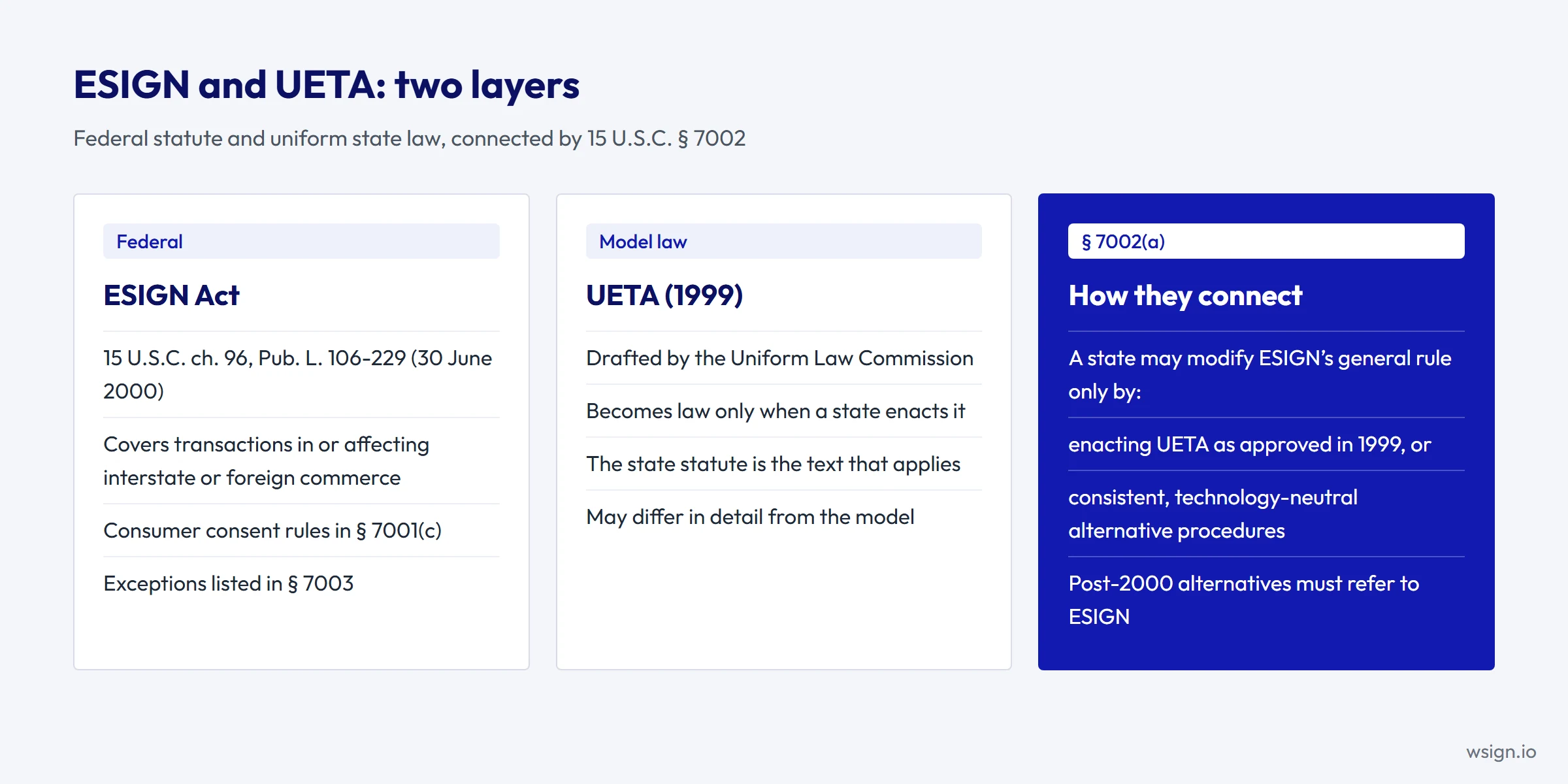
ESIGN is codified at 15 U.S.C. chapter 96 and was enacted as Public Law 106-229 on 30 June 2000. It applies to transactions in or affecting interstate or foreign commerce.
UETA is different in kind. It is not a statute by itself but a uniform act drafted by the National Conference of Commissioners on Uniform State Laws, now the Uniform Law Commission, and approved for enactment in the states in 1999. It only becomes law in a state when that state's legislature enacts it, so the text that actually applies is always the state's own statute, which may differ in detail from the model.
ESIGN anticipates this. Under 15 U.S.C. § 7002(a), a state law may modify, limit or supersede ESIGN's general rule only if it either enacts UETA as approved and recommended by the Commissioners in 1999, or sets out alternative procedures that are consistent with ESIGN and do not require or give preference to a specific technology. A state law enacted after 30 June 2000 under the second route must also refer specifically to ESIGN.
The core rule: electronic form is not a defect
Section 7001(a) has two limbs. A signature, contract or other record relating to a covered transaction may not be denied legal effect, validity or enforceability solely because it is in electronic form. And a contract may not be denied effect solely because an electronic signature or record was used in its formation.
The definition in § 7006 is wide: an electronic signature is an electronic sound, symbol or process attached to or logically associated with a contract or other record and executed or adopted by a person with the intent to sign. The key ingredient is intent, not technology. A click, a typed name or a drawn mark can all qualify if the person meant it as a signature.
Two limits follow immediately. First, § 7001(b) says ESIGN does not require anyone to agree to use or accept electronic records or signatures. Electronic signing is permitted, not imposed. Second, "solely" is doing real work: a contract can still fail for ordinary reasons, such as lack of authority, fraud, or missing terms. ESIGN removes one objection, not all of them.
Consumer consent: the part most teams get wrong
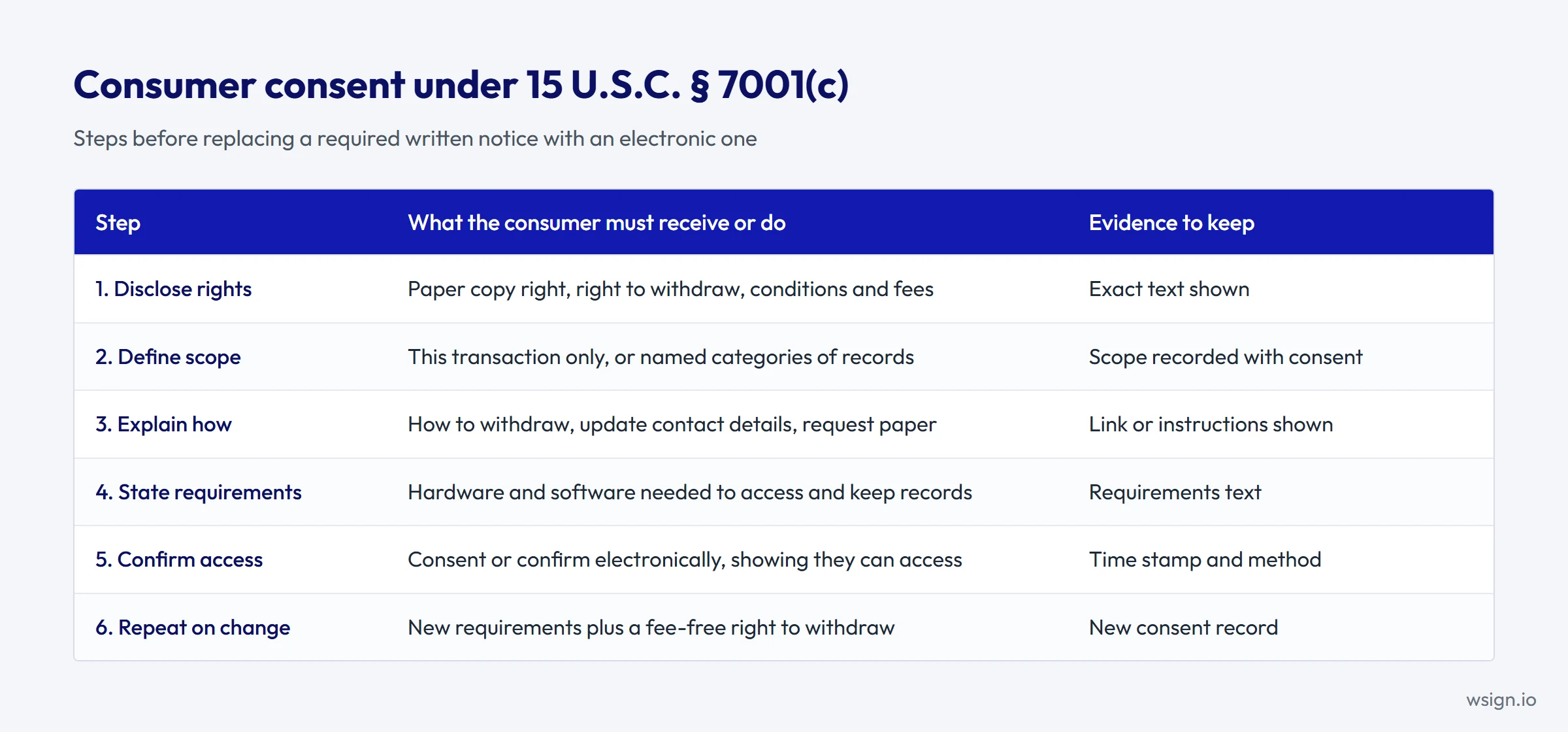
When another law requires information to be given to a consumer in writing, § 7001(c) lets you deliver it electronically only if a specific consent process has taken place. The statute defines a consumer as an individual who obtains products or services primarily for personal, family or household purposes. Business-to-business signing does not trigger these steps; consumer disclosures do.
Before the consumer consents, you must give a clear and conspicuous statement covering:
- the right to receive the record on paper, the right to withdraw consent, and any conditions, consequences or fees on withdrawal;
- whether consent covers only this transaction or identified categories of records over the relationship;
- how to withdraw consent and how to update electronic contact details;
- how to obtain a paper copy after consenting, and whether a fee applies.
You must also tell the consumer the hardware and software needed to access and keep the records. The consumer then has to consent electronically, or confirm consent electronically, in a way that reasonably demonstrates they can access information in the form you will use. If you later change your systems so that there is a material risk the consumer can no longer open or keep the records, § 7001(c)(1)(D) requires you to give the new requirements and a right to withdraw without fees, and to repeat the consent step.
One detail is worth knowing precisely. Section 7001(c)(3) says a contract with a consumer is not invalid solely because you failed to obtain the electronic consent or confirmation described in (c)(1)(C)(ii). That protects the contract, but it does not mean the disclosure obligations can be ignored; the notice itself may still not satisfy the underlying writing requirement.
A practical pattern
Imagine a hypothetical subscription service that must send consumers a written notice of terms. A defensible flow would show a short consent screen before the first document, store the exact text of that screen and the time the consumer accepted, confirm access by having them open a test document in the same format, and keep a visible link for requesting paper copies. Each of those steps maps to a clause of § 7001(c) and leaves evidence behind.
Retention: what "keeping a record" means
Many laws require businesses to retain contracts or records. Section 7001(d)(1) says an electronic record satisfies such a requirement if it accurately reflects the information in the contract or record and remains accessible to all persons entitled to access it, for the period the law requires, in a form capable of accurate reproduction for later reference. Under § 7001(d)(3), the same kind of record also satisfies a rule requiring an "original".
Section 7001(e) adds a related warning: where a law requires a contract to be in writing, the electronic version may be denied legal effect if it is not in a form that can be retained and accurately reproduced by all parties or persons entitled to retain it. In other words, a signing flow in which the counterparty can see the document but never download the signed version is a weak design.
Turning the statute into checks:
| Statutory idea | What to verify in your process |
|---|---|
| Accurately reflects the information | The stored file is the exact final version, fixed with a hash such as SHA-256. |
| Accessible to everyone entitled | Every signer receives or can download the completed document. |
| For the required period | Your retention setting covers the longest period that applies to that document type. |
| Capable of accurate reproduction | The format is standard (for example PDF) and the evidence file stays with it. |
Our article on electronic contract archiving goes further into storage design, and the piece on audit trails covers what the event log should contain.
Notarization and automated agents
Two smaller provisions often surprise people. Section 7001(g) says that if a law requires a signature or record to be notarized, acknowledged, verified or made under oath, that requirement is met if the electronic signature of the person authorized to perform the act, together with any other required information, is attached to or logically associated with the record. ESIGN does not remove the need for an authorized officer; it allows that officer to act electronically where their own rules permit.
Section 7001(h) addresses software: a contract is not invalid solely because electronic agents took part in forming it, as long as their actions are legally attributable to the person to be bound. This is relevant for automated ordering and for API-driven flows in which your system prepares and sends documents without a person clicking each step.
What ESIGN leaves out
ESIGN's general rule does not apply everywhere. Section 7003 lists exceptions, including laws governing wills, codicils and testamentary trusts, family-law matters such as adoption and divorce, most of the Uniform Commercial Code, court orders and official court documents, and several categories of consumer notices. UETA, as a model, also has its own scope section. Because these exclusions deserve careful treatment, we cover them, with a pre-send check, in a separate article on documents excluded from e-signature.
Where wsign helps
A signing platform cannot make a document valid by itself, but it can make the statutory conditions easier to meet and to prove. In wsign, every signer can download the completed document; each document receives a SHA-256 fingerprint and a trusted timestamp; and an evidence record logs who opened, verified and signed, and when. Signers can confirm a one-time code by email or WhatsApp, and you can see the full flow on how it works. Whether your consumer-consent wording satisfies a particular state or federal rule is a question for your counsel.
Frequently asked questions
Do I need consumer consent for business-to-business contracts?
The § 7001(c) process applies where a law requires information to be provided to a consumer in writing. A contract between two businesses does not trigger it, although the parties still cannot be forced to use electronic records under § 7001(b).
Which applies in my state, ESIGN or UETA?
Both can be relevant. ESIGN sets the federal rule, and § 7002 allows a state's enactment of UETA, or a consistent technology-neutral alternative, to modify it within limits. Check your state's statute rather than the model text.
Is a typed name enough under ESIGN?
The § 7006 definition covers any electronic sound, symbol or process adopted with intent to sign. A typed name can qualify; whether it is persuasive evidence in a dispute depends on what else you recorded about who typed it.
Does ESIGN let me notarize documents online?
Section 7001(g) allows the authorized officer's electronic signature to satisfy a notarization requirement. It does not create a notary or replace the rules that govern notaries in each state.
To try a signing flow that gives every party the final document and its evidence record, open a wsign account.
This article is general information, not legal advice.