Electronic signature laws are generous, but they are rarely universal. Almost every framework that says "electronic form is no reason to deny validity" also contains a short list of documents that it leaves to older rules: wills, family matters, court papers, transfers of land, and certain notices that protect people at vulnerable moments.
Those lists are not identical from country to country, and they change. This article does not try to give you a global table of what is excluded where. Instead, it shows the patterns that recur in the primary texts, quotes three of them as worked examples, and gives you a repeatable check to run before you send a document for electronic signature.
Why laws carve out some documents
The carve-outs are not arbitrary. They tend to protect one of three things:
- Solemnity. Some acts are meant to be slow and deliberate, such as making a will or creating a deed. Formal steps like witnesses force a pause and give evidence later.
- Public registers and courts. Land registries, courts and public authorities run their own procedures and decide what they will accept.
- People who may not see an electronic message in time. Notices about losing a home, utilities or insurance carry serious consequences; lawmakers have often required that they reach people on paper.
Keeping these three reasons in mind helps when you meet a document type that no list mentions: ask whether it is solemn, whether a public body will receive it, or whether it is a protective notice to an individual.
Three sourced examples
United States: ESIGN § 7003
The US federal ESIGN Act states its exceptions in 15 U.S.C. § 7003. Its general validity rule does not apply to a contract or record to the extent it is governed by a statute or rule governing:
- the creation and execution of wills, codicils or testamentary trusts;
- adoption, divorce or other matters of family law;
- the Uniform Commercial Code, other than sections 1-107 and 1-206 and Articles 2 and 2A.
Section 7003(b) adds further categories: court orders, notices and official court documents; notices of cancellation or termination of utility services; notices of default, acceleration, repossession, foreclosure or eviction, or the right to cure, under a credit agreement secured by, or a rental agreement for, a primary residence; notices of cancellation or termination of health insurance or life insurance benefits (excluding annuities); product recall notices where a failure risks health or safety; and documents required to accompany the transportation or handling of hazardous materials.
Section 7003(c) also allows a federal regulatory agency, after notice and public comment, to extend the general rule to an excepted category within its jurisdiction if it finds the exception is no longer necessary for consumer protection. So the list can narrow over time, which is one more reason to check rather than rely on memory. For the rest of ESIGN, see our explainer on ESIGN and UETA.
European Union: two layers to read together
In the EU, the eIDAS Regulation decides what an electronic signature is worth, but it deliberately stays out of form requirements. Article 2(3) of Regulation 910/2014, as amended, says the regulation does not affect Union or national law related to the conclusion and validity of contracts, other legal or procedural obligations relating to form, or sector-specific requirements relating to form. Put simply, a national rule that requires a notary or a handwritten signature for a given document still applies. Our guide to eIDAS signature levels covers the rest of the regulation.
A second EU text shows where such national rules are most likely to be found. Article 9 of the Electronic Commerce Directive 2000/31/EC requires Member States to allow contracts to be concluded by electronic means, but Article 9(2) lets them exclude all or some contracts in four categories:
- contracts that create or transfer rights in real estate, except for rental rights;
- contracts requiring by law the involvement of courts, public authorities or professions exercising public authority;
- contracts of suretyship granted, and collateral securities furnished, by persons acting outside their trade, business or profession;
- contracts governed by family law or by the law of succession.
Member States must tell the Commission which categories they exclude under Article 9(3). Because each state chooses for itself, the honest answer to "is X excluded in the EU?" is often "it depends on the Member State".
England and Wales: wills
Some exclusions are not written as exceptions to an e-signature law at all; they arise because another statute sets its own formalities. Section 9 of the Wills Act 1837 requires a will to be in writing and signed by the testator, with the signature made or acknowledged in the presence of two or more witnesses present at the same time, each of whom attests and signs. A temporary rule allowing presence by video applied only to wills made between 31 January 2020 and 31 January 2024. Our article on UK electronic signature law covers deeds and witnessing in more detail.
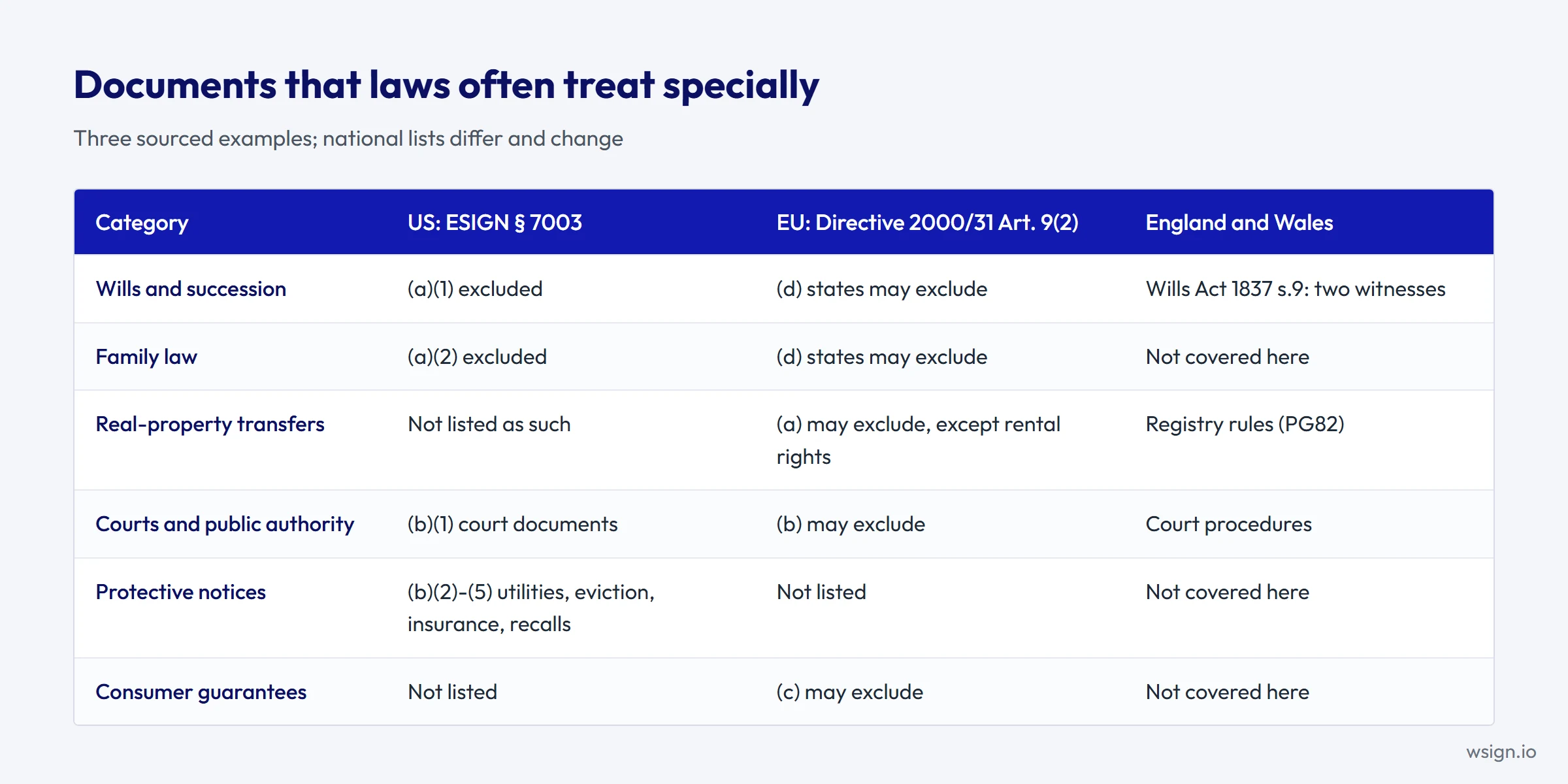
The categories that recur
| Category | Where it appears in the sources above | What to do |
|---|---|---|
| Wills and succession | ESIGN § 7003(a)(1); Directive 2000/31 Art. 9(2)(d); Wills Act 1837 s.9 | Treat as out of scope for standard e-signature. |
| Family law (adoption, divorce) | ESIGN § 7003(a)(2); Directive Art. 9(2)(d) | Follow the court or registry procedure. |
| Real-property transfers | Directive Art. 9(2)(a) | Check national law and the land registry's rules. |
| Court documents | ESIGN § 7003(b)(1); Directive Art. 9(2)(b) | Use the court's own filing system. |
| Protective notices to individuals | ESIGN § 7003(b)(2)-(5) | Check whether paper delivery is required. |
| Consumer guarantees | Directive Art. 9(2)(c) | Check national rules before signing electronically. |
Two cautions. First, an exclusion from a general e-signature rule does not always mean "paper only". It means the general rule does not help you, and the document's own rules decide. Some of those rules now allow electronic methods of their own, often with extra conditions. Second, the absence of a category from one list does not make it safe elsewhere; Gulf and other national laws, many built on UNCITRAL models, have their own scope provisions. Our article on UNCITRAL model laws explains that shared background.
A "check before you send" process
Most teams do not need to memorise lists. They need a habit that catches the unusual document before it goes out. The following routine fits into an internal review step.
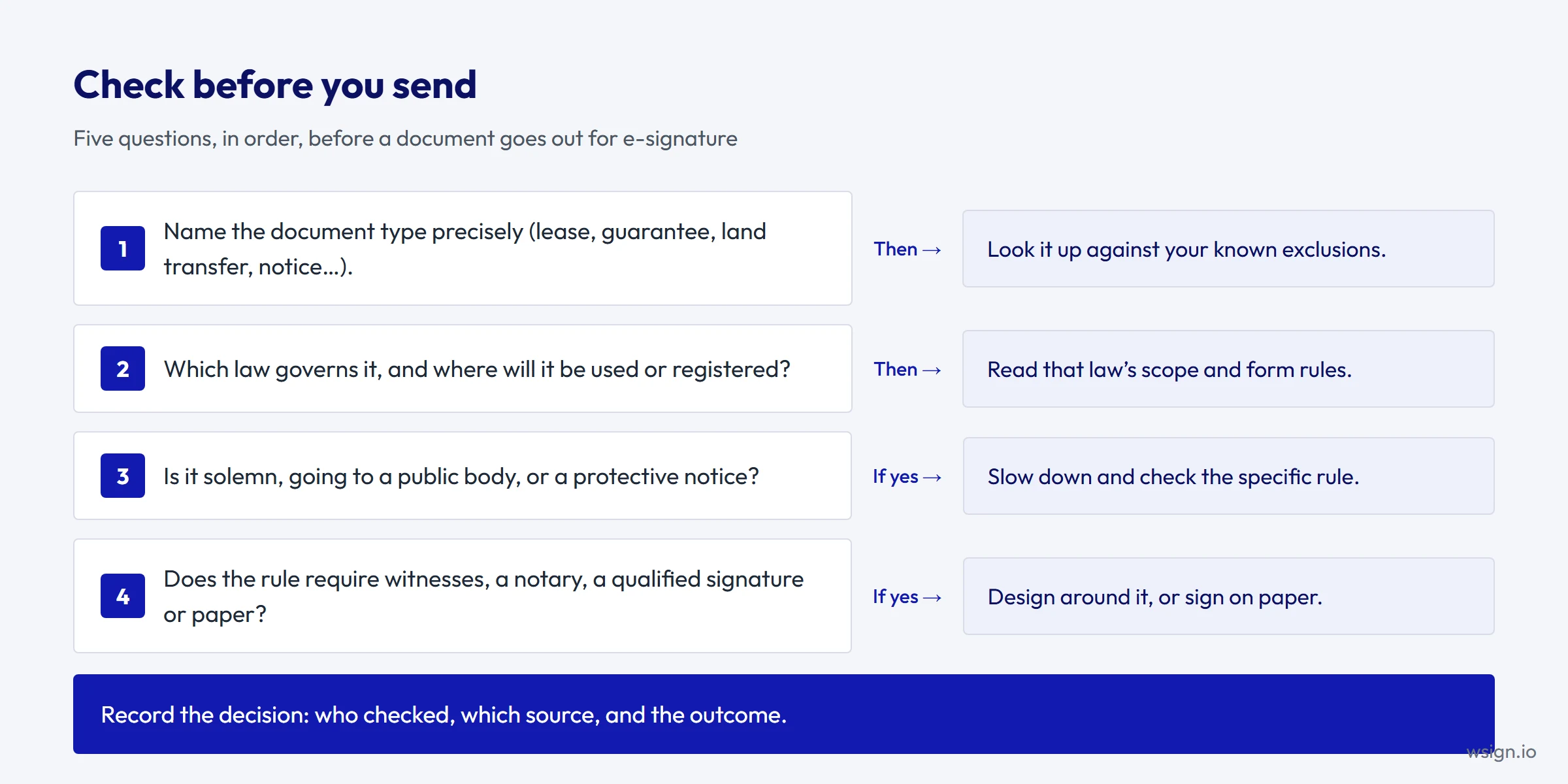
- Name the document type precisely. "Agreement" is not enough. Is it a lease, a land transfer, a guarantee, a power of attorney, a court filing, a notice of termination?
- Identify the governing law and the signers' locations. The rules of the law that governs the document, and sometimes of the place where it will be used or registered, are the ones that matter.
- Ask the three-reasons question. Is it solemn, will a public body receive it, or is it a protective notice to an individual? If yes to any, slow down.
- Check the specific rule. Look up the statute, the registry's published guidance or the court's rules. If they set formalities such as witnesses, notarisation or a qualified signature, design the signing around them, or sign on paper.
- Record the decision. Note who checked, what source they relied on and the outcome. If the decision is later questioned, you can show it was made deliberately.
Teams that already route contracts through an internal review and approval workflow can add these five questions to the reviewer's checklist. Our article on common contract signing mistakes covers other issues worth catching at the same stage.
A hypothetical example
Imagine a property company that signs residential leases, renewal letters and, occasionally, a sale of land. Leases and renewals usually fall within general e-signature rules, so they move through the normal flow. A notice that starts an eviction process is a different matter: in the US, ESIGN § 7003(b)(3) excludes eviction notices under a rental agreement for a primary residence, so the team sends it in the form the applicable law requires. The land sale goes to the conveyancer, who follows national law and the land registry's rules. The same company, three different paths, decided by the check above rather than by habit.
Where wsign fits
wsign does not decide whether a document may be signed electronically; that depends on the governing law. What it can do is support the routine around that decision: an internal review step before sending, a choice of signer verification level, and an evidence record for every document that does go out. For teams in real estate or legal work, where excluded categories are most common, the review step is the natural place to run the check. More on our approach is on the compliance page. Where a document sits near one of these categories, consult counsel in the relevant country.
Frequently asked questions
Can a will be signed electronically?
Under the sources above, wills are generally outside the standard electronic-signature rules: ESIGN excludes laws governing wills, the EU Directive allows states to exclude succession law contracts, and the Wills Act 1837 in England and Wales requires witnesses present at the same time. Check the law that governs the will.
Are real-estate contracts always excluded?
No. The EU Directive allows Member States to exclude contracts that create or transfer rights in real estate, but rental rights are expressly outside that category, and each state decides. Registries may also publish their own rules on electronic signatures.
If a document is excluded, does it have to be on paper?
Not necessarily. Exclusion means the general e-signature rule does not apply. The document's own legal rules then decide, and some of them allow electronic methods under specific conditions.
Do these lists ever change?
Yes. ESIGN § 7003(c) allows federal agencies to remove exceptions within their jurisdiction after public comment, and EU Member States report their exclusions under Directive Article 9(3). Check the current text before relying on any list.
To add a pre-send review step and a full evidence record to your own documents, create a wsign account.
This article is general information, not legal advice.