If you sign contracts with companies or people in the European Union, sooner or later someone will ask whether your signature is "simple", "advanced" or "qualified". Those three words come from one regulation, eIDAS, and they decide how much a court will presume about a signature before anyone has to prove anything.
This guide reads the regulation itself rather than summaries of it. It explains what each level means in the text, what the law actually promises for each one, what the 2024 amendment (often called eIDAS 2) added, and how a business outside the EU can plan its signing so that European counterparties are comfortable with it.
Where the rules come from
The base text is Regulation (EU) No 910/2014, which has applied since 1 July 2016. Because it is a regulation and not a directive, it applies directly in every Member State without being rewritten into national law. In April 2024 it was amended by Regulation (EU) 2024/1183, which established the European Digital Identity Framework and entered into force twenty days after its publication on 30 April 2024. The current wording sits in the consolidated version on EUR-Lex, and that is the text quoted below.
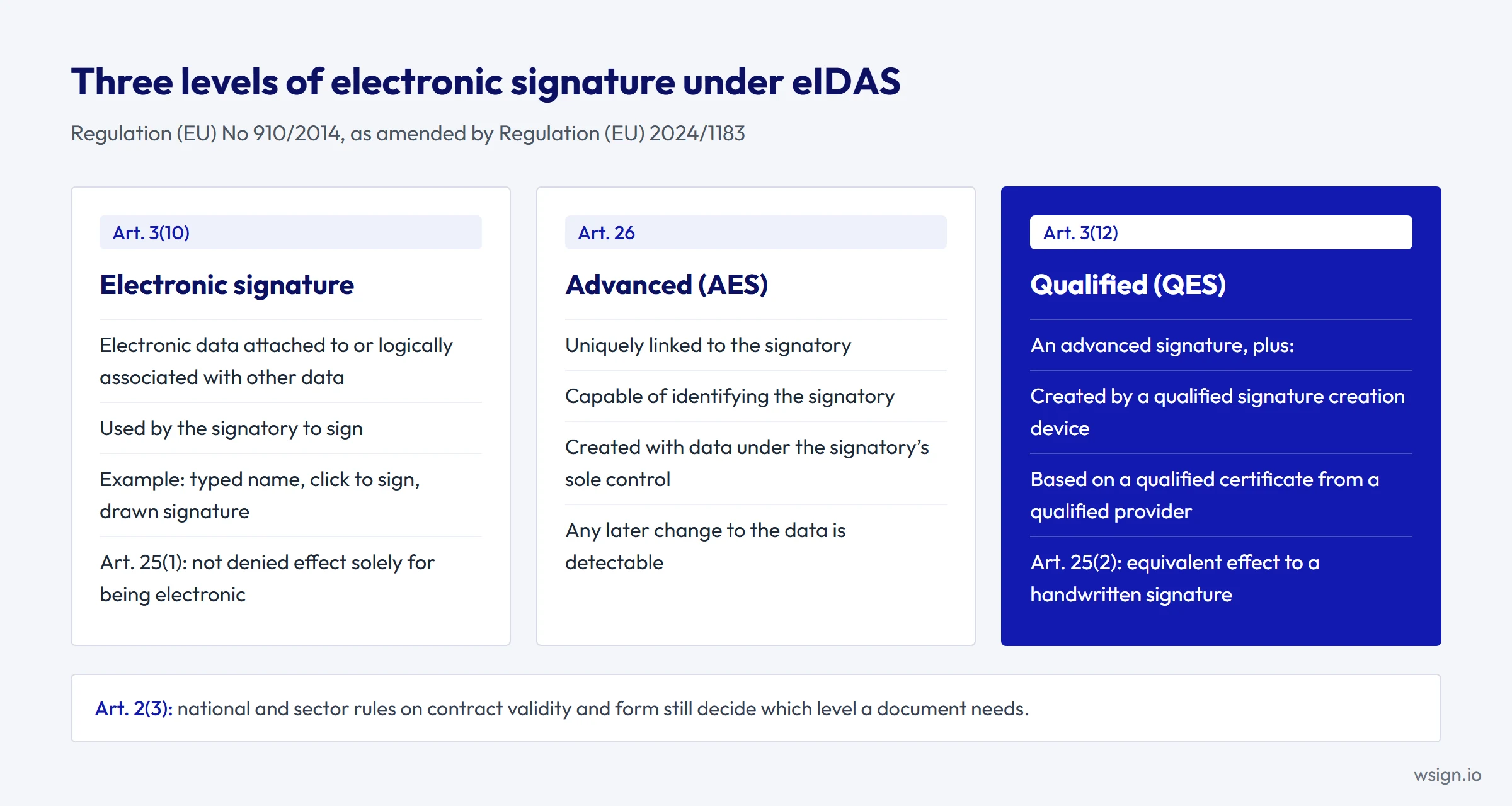
One point is easy to miss: eIDAS does not tell you when a contract needs a signature at all, or what form a particular contract must take. Article 2(3) says the regulation does not affect Union or national law on the conclusion and validity of contracts, other legal or procedural obligations relating to form, or sector-specific form requirements. So eIDAS answers "what is this signature worth?", while national contract law still answers "is this kind of signature enough for this kind of document?".
The three levels, read from the text
Electronic signature (often called "simple")
Article 3(10) defines an electronic signature as data in electronic form attached to or logically associated with other data, which the signatory uses to sign. That is a deliberately low bar. A typed name at the end of an email, a click on an "I agree and sign" button, or a drawn signature placed on a PDF can all fall within it. The regulation itself does not use the word "simple"; it is shorthand that practitioners use for an electronic signature that is not advanced or qualified.
Advanced electronic signature (AES)
Article 26 lists four requirements. An advanced electronic signature must be:
- uniquely linked to the signatory;
- capable of identifying the signatory;
- created using signature creation data that the signatory can, with a high level of confidence, use under their sole control; and
- linked to the signed data in such a way that any later change to the data is detectable.
None of these requirements names a technology. In practice, the fourth one points toward cryptography: a signature computed over a hash of the document breaks as soon as a single byte changes. The second and third push the provider to know who the signer is and to show that only that person could have triggered the signature, which is why identity checks and one-time codes appear so often in AES designs.
Qualified electronic signature (QES)
Under Article 3(12), a qualified electronic signature is an advanced signature that is created by a qualified signature creation device and is based on a qualified certificate for electronic signatures. Article 3(15) adds that a qualified certificate must be issued by a qualified trust service provider and meet the requirements of Annex I. Qualified providers appear on the trusted lists that each Member State publishes, and a QES can be checked against those lists.
What the law promises at each level
Article 25 is short, and its two paragraphs carry most of the practical weight:
- Paragraph 1: an electronic signature shall not be denied legal effect and admissibility as evidence in legal proceedings solely because it is electronic or because it does not meet the requirements for qualified signatures.
- Paragraph 2: a qualified electronic signature has the equivalent legal effect of a handwritten signature.
The 2014 text adds a third paragraph on cross-border recognition: a QES based on a qualified certificate issued in one Member State is recognised as a QES in all other Member States.
Read together, the rules create a gradient of burden rather than a line between "valid" and "invalid". A simple or advanced signature cannot be thrown out just for being electronic, but if it is disputed, the party relying on it has to show who signed and that the document was not changed. A QES starts with the strongest statutory position available. Notice also what Article 25 does not say: it gives no special presumption to the AES level. Its value lies in the evidence it produces (identity linkage and tamper detection), not in a statutory shortcut.
Choosing a level: a practical way to think about it
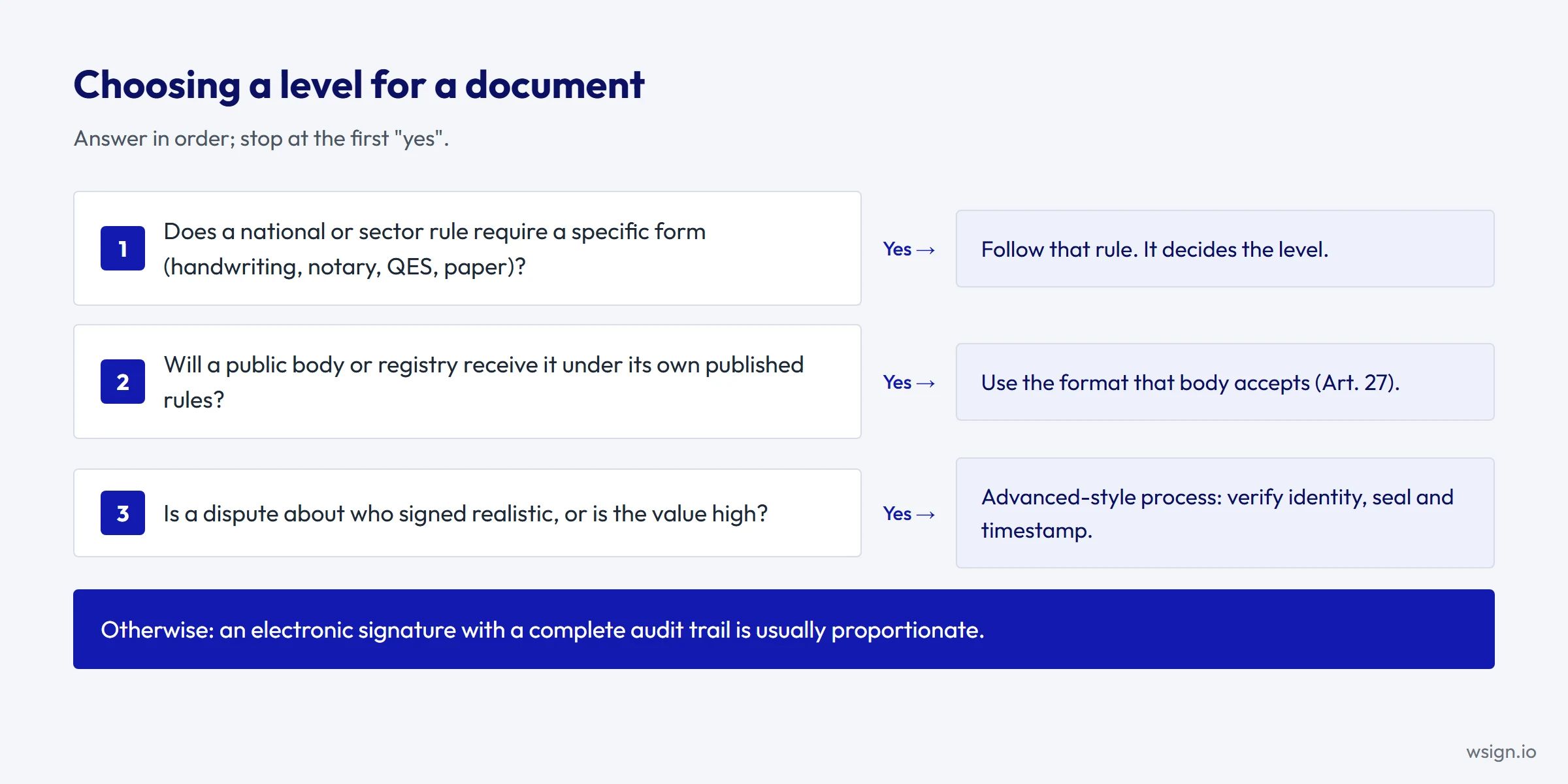
The level is a risk decision, not a prestige decision. Three questions usually settle it.
1. Does any rule require a particular form?
Because of Article 2(3), national or sector rules may require a handwritten signature, a notary, a qualified signature, or a paper original for certain documents. If such a rule applies, it decides the matter. Our sibling article on documents that are often excluded from e-signature walks through the usual categories.
2. How likely is a dispute about who signed?
For an internal acknowledgement or a routine purchase order between long-standing partners, the realistic dispute is about terms, not about identity. A simple signature with a clear audit trail is usually proportionate. For example, imagine an agreement with a new counterparty you have never met, with significant sums at stake: the question "was it really them?" becomes plausible, and an advanced-style process with identity verification is the better fit.
3. Will the document be relied on by third parties or public bodies?
Some public services set their own requirements. Article 27 deals with cases where a Member State requires an advanced signature to use an online public service, and says the state must then recognise advanced signatures, advanced signatures based on qualified certificates, and qualified signatures in the formats defined in implementing acts. If a registry, tender portal or authority is the final recipient, check its published rules before choosing.
| Situation (hypothetical) | Typical starting point | Why |
|---|---|---|
| Staff acknowledging a new internal policy | Simple, with a full audit trail | Identity is known through company accounts; the risk is low. |
| Services agreement with a new overseas client | Advanced-style process | Identity linkage and tamper detection matter if signature is disputed. |
| Document where a national rule requires a QES | Qualified | The form rule decides; nothing lower satisfies it. |
What eIDAS 2 changed
The 2024 amendment did not rewrite Articles 25 and 26. Its centre of gravity is digital identity. The headline change is the European Digital Identity Wallet. Article 5a obliges each Member State to provide at least one wallet within 24 months of the entry into force of the implementing acts it refers to, and Article 3(42) describes the wallet as a means that lets the user store and share identification data and attestations of attributes, and also sign with qualified electronic signatures or seal with qualified seals.
Two further details matter for signing:
- Free qualified signatures for individuals. Article 5a(5)(g) requires wallets to let all natural persons sign by means of qualified electronic signatures by default and free of charge. Member States may limit the free use to non-professional purposes.
- A wider list of trust services. The definition of "trust service" in Article 3(16) now runs from (a) to (n) and includes electronic attestations of attributes, electronic archiving and electronic ledgers, alongside signatures, seals, timestamps and registered delivery.
The practical consequence is gradual: as wallets reach citizens, more EU individuals will hold a qualified signing tool on their phones. A counterparty who could not easily produce a QES before may be able to do so later, which can change what a European partner asks of you.
If your business is outside the EU
eIDAS governs what an electronic signature is worth within the EU legal order; it does not reach out and regulate your company abroad. But if a contract is governed by the law of a Member State, or may be enforced before an EU court, its rules will shape how the signature is assessed. A workable approach has four parts:
- Agree the method in the contract. A short clause in which the parties agree to sign electronically and accept the chosen method reduces later argument.
- Collect evidence the way an AES would. Even when you do not need a formal AES, design the process around its four requirements: identify the signer, tie the signature to that person, record how they authenticated, and seal the document so changes show. Our article on electronic versus digital signatures explains the cryptographic side.
- Keep the timestamps and hashes. A trusted timestamp and a SHA-256 fingerprint of the final file show when the document existed and that it has not changed since.
- Let the counterparty sign with their own qualified tool when they need to. If a European partner must use a QES, the signature comes from their qualified provider, not from your platform.
The UK left the EU and kept its own version of these rules; see our guide to electronic signature law in the UK for how it differs.
How wsign fits into this picture
wsign is not a qualified trust service provider and does not issue qualified signatures. What it does is help you build the evidence that the AES requirements describe: signer identity verification by an external specialised provider, one-time codes by email or WhatsApp, a SHA-256 fingerprint and trusted timestamp on the final document, an evidence certificate with the full audit trail, and a public verification page. Where a signer holds a token certificate from a licensed certification provider, they can sign with it. You can read more on our compliance page. Whether a given process meets a specific legal requirement in a given country is a question for local counsel.
Frequently asked questions
Is a simple electronic signature valid in the EU?
Article 25(1) says it cannot be denied legal effect or admissibility as evidence solely because it is electronic or not qualified. Whether it suffices for a particular document depends on national form rules, and if it is disputed, the party relying on it must prove who signed.
Does an advanced signature have to use a certificate?
Article 26 does not require one. It sets four outcome-based requirements. Certificates and cryptographic sealing are common ways to meet them, but the text is technology neutral.
Can a QES issued in one Member State be used in another?
The 2014 text of Article 25(3) provides that a QES based on a qualified certificate issued in one Member State is recognised as a QES in all others.
Does the EU Digital Identity Wallet replace other signing methods?
No. It adds a qualified signing option for wallet holders. Articles 25 and 26 still apply to every other kind of electronic signature.
If you want to see how identity checks, timestamps and evidence files come together in one signing flow, you can create a wsign account and send a test document.
This article is general information, not legal advice.