UK law on electronic signatures is not found in one statute. It is a layered picture: a short section of a 2000 Act on evidence, a retained version of the EU eIDAS Regulation, centuries of common law on what a "signature" is, and a 2019 report by the Law Commission that pulled those threads together. For most commercial contracts the answer is reassuring. For deeds, wills and some registrations, the details still matter.
This guide focuses on England and Wales, notes where Scotland takes a different route, and points to the official texts on legislation.gov.uk and the Law Commission's site so that you can check each statement yourself.
The statutory layer: Electronic Communications Act 2000
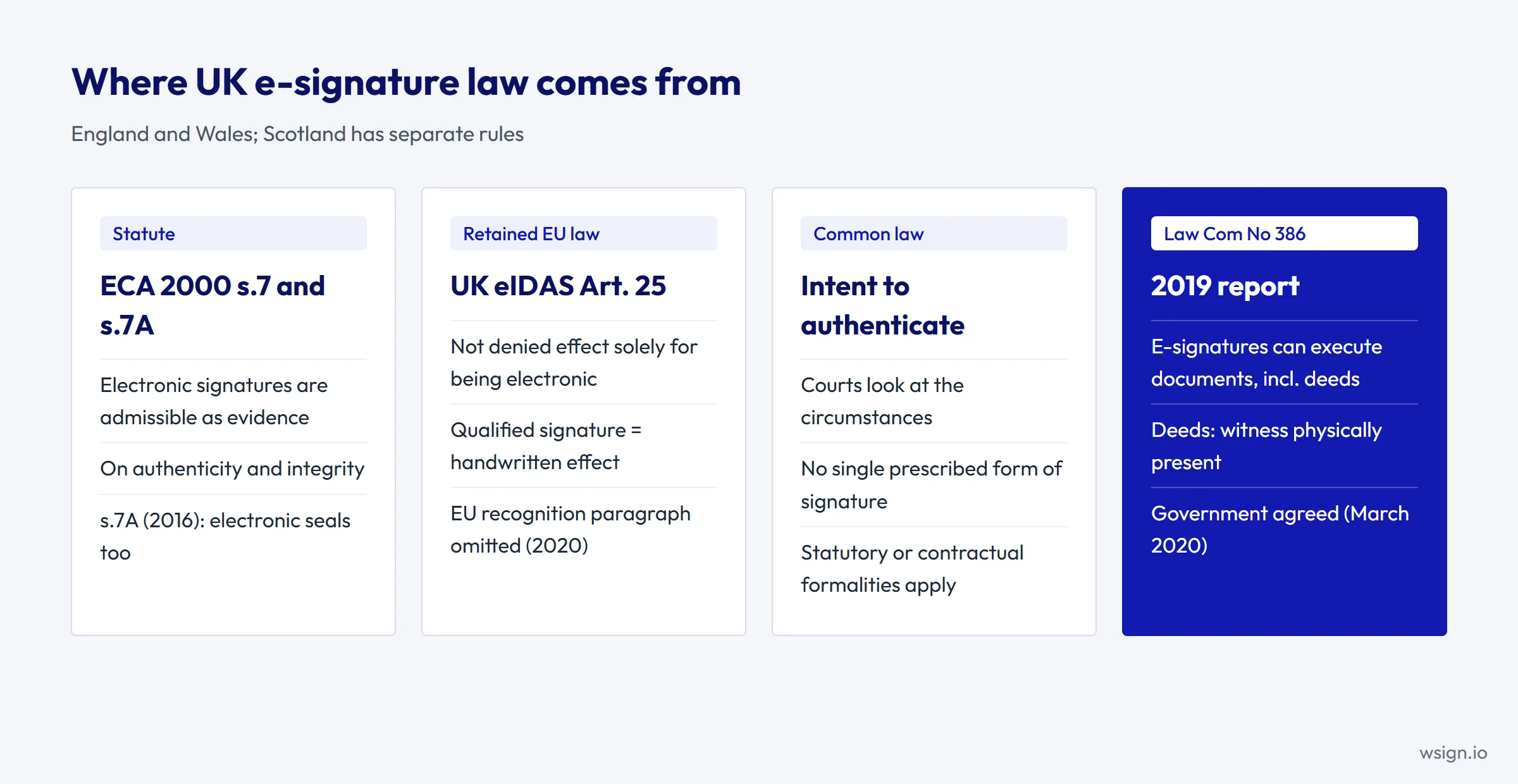
Section 7 of the Electronic Communications Act 2000 is an evidence provision. In legal proceedings, an electronic signature incorporated into or logically associated with a particular electronic communication or data, and the certification of that signature by any person, are each admissible in evidence on any question as to the authenticity or integrity of that communication or data.
Section 7(2) describes an electronic signature broadly: anything in electronic form that is incorporated into or otherwise logically associated with any electronic communication or data, and that purports to be used by the individual creating it to sign. Section 7(3) explains what "certified" means: someone has made a statement confirming that the signature, a means of producing or verifying it, or a procedure applied to it, is a valid means of signing.
Note what section 7 does and does not do. It makes electronic signatures admissible; it does not, by itself, say that every electronic signature satisfies every legal requirement for a signature. That second question is answered by the common law and by the specific rules that apply to particular documents.
Section 7 was amended on 22 July 2016 by SI 2016/696, which also inserted section 7A. Section 7A applies the same admissibility approach to electronic seals, which are used by organisations rather than individuals, covering questions of authenticity, integrity, or both.
The retained eIDAS layer
When the UK left the EU, Regulation 910/2014 was kept in domestic law in amended form, often called UK eIDAS. Its Article 25 keeps two familiar rules. An electronic signature shall not be denied legal effect and admissibility as evidence solely because it is electronic or does not meet the requirements for qualified signatures; and a qualified electronic signature has the equivalent legal effect of a handwritten signature.
The third paragraph, on recognition of qualified signatures between EU Member States, was omitted with effect from 31 December 2020 by SI 2019/89. The practical effect is that the UK text no longer contains the cross-border recognition rule that EU Member States apply among themselves. For how the EU version has since developed, see our guide to eIDAS 2 and the SES, AES and QES levels.
The common law and the Law Commission's 2019 report
English law has long been flexible about what counts as a signature. In 2019 the Law Commission of England and Wales published its report Electronic Execution of Documents (Law Com No 386), after a consultation in 2018. Its central conclusion is that an electronic signature is capable in law of being used to execute a document, including a deed, provided that:
- the person signing intends to authenticate the document; and
- any formalities relating to execution of that document are satisfied, whether they come from statute or from a contract.
The report also observes that courts generally do not prescribe a particular form of signature and look at the circumstances, and that electronic equivalents of non-electronic forms of signature are likely to be recognised. The government responded in March 2020, agreeing with the legal conclusions and committing to set up an industry working group on security and technology, which the report had recommended. The report additionally suggested that government might consider codifying the law on electronic signatures and that a future review of the law of deeds should consider whether deeds remain fit for purpose.
For businesses, the report's two conditions are a useful design brief. "Intention to authenticate" means the signer should see what they are signing and take a deliberate step to sign it. "Formalities satisfied" means checking whether the document type carries its own rules, such as witnessing.
Deeds and witnessing: where physical presence still matters
Deeds are the main area where electronic signing needs extra care. The Law Commission's position is that a deed must be signed in the physical presence of a witness who attests the signature, and that this remains true even when both the signer and the witness sign electronically. A witness watching over a video call does not meet that requirement under the current law as the report describes it; the report recommended that the industry working group look at the obstacles to video witnessing, with legislative reform as a possible next step.
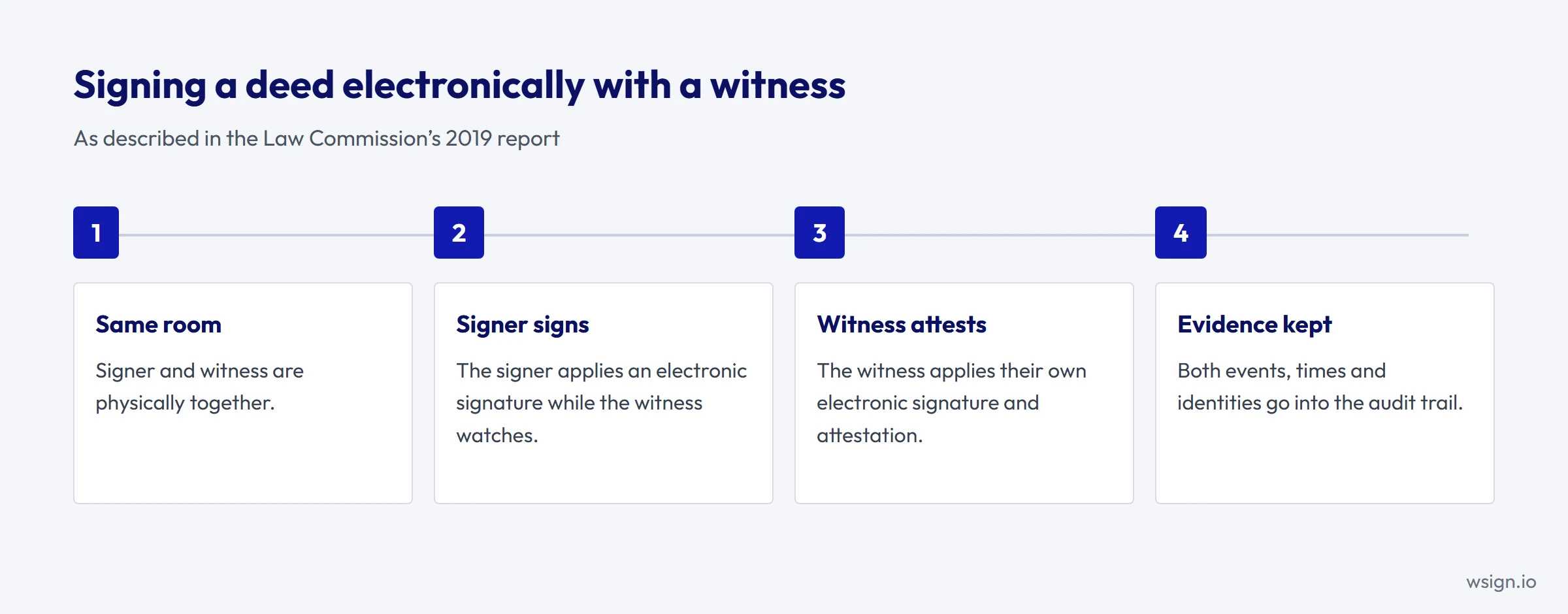
So an electronic deed flow, where permitted, looks like this in practice:
- The signer and the witness are in the same room.
- The signer applies their electronic signature while the witness watches.
- The witness then applies their own electronic signature and attestation, normally using their own access to the document.
- The platform records both events, with times and identities, in the audit trail.
Registration adds another layer. HM Land Registry publishes its own Practice Guide 82 on which electronic signatures it accepts for which documents. If a deed must be registered, its rules decide what will be accepted, regardless of what contract law would otherwise allow.
Wills: a separate statute
Wills are governed by section 9 of the Wills Act 1837, which requires a will to be in writing and signed by the testator, with the signature made or acknowledged in the presence of two or more witnesses present at the same time, each of whom attests and signs. A temporary amendment allowed presence by video for wills made between 31 January 2020 and 31 January 2024; the version on legislation.gov.uk shows that period ending and no later extension. Wills are therefore not a candidate for a standard electronic signing flow.
Scotland follows its own rules
Scotland has a separate legal system. For documents that the Requirements of Writing (Scotland) Act 1995 requires to be in writing, regulation 2 of the Electronic Documents (Scotland) Regulations 2014 says an electronic version is valid only if the granter's electronic signature is an advanced electronic signature incorporated into or logically associated with the document. If a contract or its parties have a Scottish connection, ask Scottish counsel which documents fall under the 1995 Act.
Putting it together: a working checklist
| Document type | What to check first | Typical approach |
|---|---|---|
| Commercial contract (simple contract) | Any contractual formality agreed between the parties | Electronic signature with clear intent and an audit trail |
| Deed | Witnessing rules; whether it will be registered | Electronic signing with a physically present witness, if the recipient accepts it |
| Will | Wills Act 1837 s.9 | Outside standard e-signature flows |
| Document governed by Scots law | Requirements of Writing (Scotland) Act 1995 | Advanced electronic signature where the Act applies |
Beyond these categories, the most common practical failures are not legal but evidential: nobody can later show who signed, or which version they saw. That is why a fingerprint of the final file, a timestamp and a signer verification step matter even where the law is relaxed about form. Our article on verifying a signed document shows how a recipient can check those details later.
Where wsign fits
wsign supports the evidence side of this picture: each signer's verification step and actions are logged, the final document receives a SHA-256 fingerprint and a trusted timestamp, and anyone holding the document can check it on a public verification page. Organisations can also apply a company seal alongside personal signatures. wsign does not decide whether a deed's witnessing requirements, a registry's rules or Scots law are met in a particular case; that assessment belongs with your solicitor. You can read more on our compliance page.
Frequently asked questions
Is an electronic signature on a commercial contract valid in England?
The Law Commission concluded that an electronic signature is capable of executing a document where the signer intends to authenticate it and any applicable formalities are met. For most simple contracts there is no special formality, but the parties can agree one.
Can a deed be witnessed over video?
According to the Law Commission's report, a deed must be signed in the physical presence of a witness, even when signatures are electronic. The report recommended further work on video witnessing rather than treating it as already permitted.
Does the UK still recognise EU qualified signatures automatically?
The retained UK text of Article 25 keeps the rule that a qualified signature has the effect of a handwritten one, but the paragraph on recognition between Member States was omitted from 31 December 2020.
Are electronic company seals admissible?
Section 7A of the Electronic Communications Act 2000, inserted in 2016, makes electronic seals and their certification admissible on questions of authenticity and integrity.
If you want a signing flow that records intent, identity checks and the final file's fingerprint in one evidence record, start with a wsign account.
This article is general information, not legal advice.