If you have read the electronic transactions laws of several countries side by side, you may have noticed that they often use strikingly similar sentences. That is not a coincidence. Many of them trace back to a small set of texts prepared by the United Nations Commission on International Trade Law (UNCITRAL), which drafts model laws and conventions that states can adopt or adapt.
This article explains those texts in the order they appeared, the three principles that run through all of them, and what that shared ancestry means in practice for a business signing contracts across the Gulf, the wider Middle East and beyond. It also explains why a common origin does not mean identical rules.
Model law or convention: two different instruments
UNCITRAL produces two main kinds of legal text, and the difference matters:
- A model law is a blueprint. It has no legal force by itself. A state decides whether to base its own legislation on it and is free to change wording, add conditions or leave parts out.
- A convention is a treaty. It binds the states that become parties to it, subject to any declarations they make, and it enters into force under its own terms.
So when a country is said to have "adopted" a model law, the accurate meaning is that its national legislation is based on or influenced by that model. UNCITRAL's own status pages say as much: the lists are indicative of enactments made known to the Secretariat, and each state's legislation should be checked to see how it departs from the model.
The texts, in order
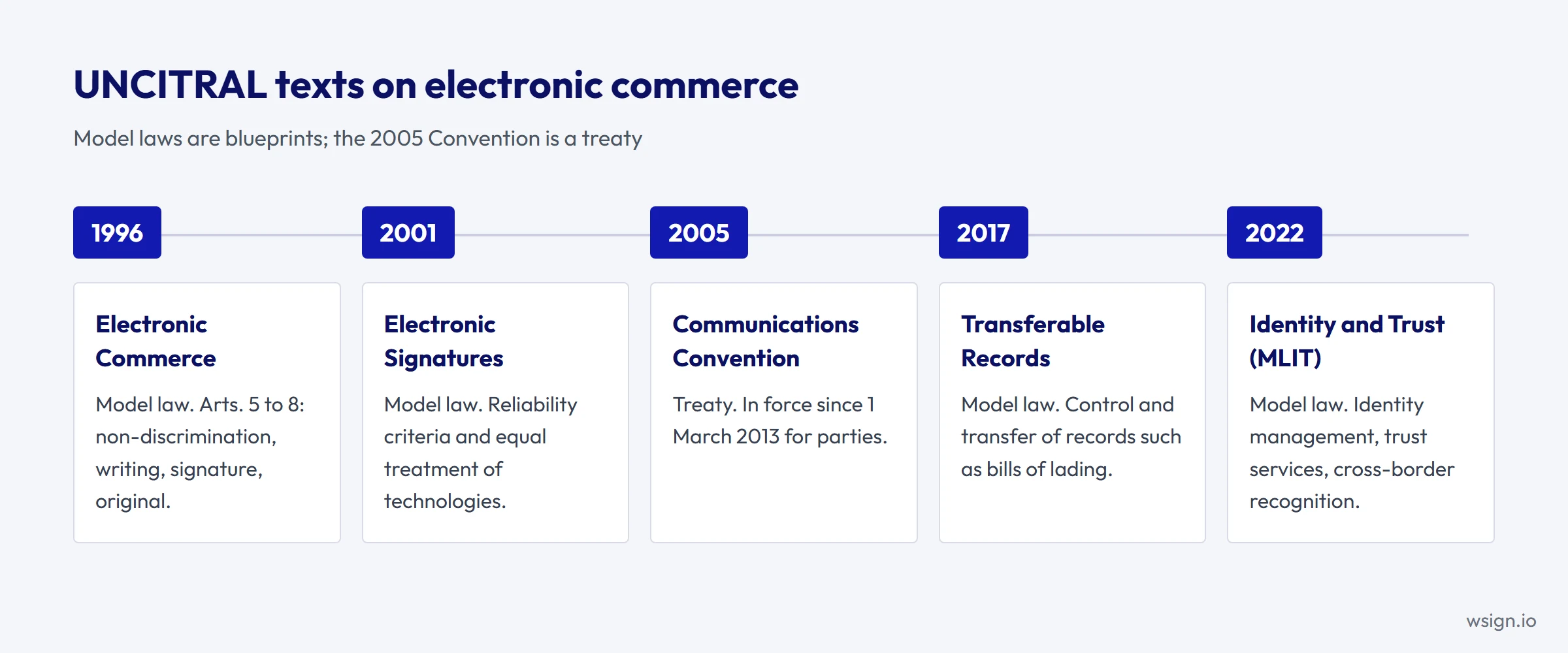
1996: Model Law on Electronic Commerce
The Model Law on Electronic Commerce, endorsed by the UN General Assembly in resolution 51/162 in 1996, set the pattern. Its core provisions are short:
- Article 5: information shall not be denied legal effect, validity or enforceability solely on the grounds that it is in the form of a data message.
- Article 6: where the law requires writing, a data message meets the requirement if the information is accessible so as to be usable for subsequent reference.
- Article 7: where the law requires a signature, the requirement is met if a method is used to identify the person and indicate their approval of the information, and that method is as reliable as was appropriate for the purpose, in the light of all the circumstances.
- Article 8: addresses "original" form, built around a reliable assurance as to the integrity of the information.
Article 7 is the sentence you will recognise in many national laws. It does not name a technology. It asks two functional questions: does the method identify the signer and show their approval, and is it reliable enough for this purpose?
2001: Model Law on Electronic Signatures
The Model Law on Electronic Signatures, adopted on 5 July 2001, develops Article 7 further. It sets out criteria for when an electronic signature is considered reliable, including that the signature creation data are linked to the signatory in the context in which they are used. Its Article 3 is titled "equal treatment of signature technologies", and UNCITRAL describes the model as allowing legislation that recognises both cryptographic digital signatures based on public key infrastructure and electronic signatures that use other technologies. It also favours recognising foreign certificates and signatures on the basis of substantive equivalence, regardless of where they originate.
2005: Electronic Communications Convention
The United Nations Convention on the Use of Electronic Communications in International Contracts was adopted on 23 November 2005 and entered into force on 1 March 2013. As a treaty, it applies to international contracts among parties in contracting states, subject to declarations each state may make. It carries the same functional-equivalence approach into a binding instrument for cross-border dealings.
2017: Model Law on Electronic Transferable Records
The Model Law on Electronic Transferable Records addresses documents such as bills of lading and promissory notes, where the question is not only "who signed?" but "who controls the record and can transfer it?". It is less central to everyday contract signing, but it completes the family.
2022: Model Law on Identity Management and Trust Services
The Model Law on the Use and Cross-border Recognition of Identity Management and Trust Services (MLIT) was adopted on 7 July 2022. It has four chapters: general provisions, identity management, trust services and cross-border recognition. Its trust-services chapter covers functions such as electronic signatures, electronic seals, electronic timestamps and electronic archiving. Article 3 states that it does not require anyone to use these services without their consent. In effect, MLIT brings to the UNCITRAL family the identity and trust-service ideas that the EU addressed in eIDAS.
The three principles that tie them together
UNCITRAL describes its electronic commerce texts as resting on three principles. Understanding them is more useful than memorising any single article, because they explain how courts and drafters tend to reason.
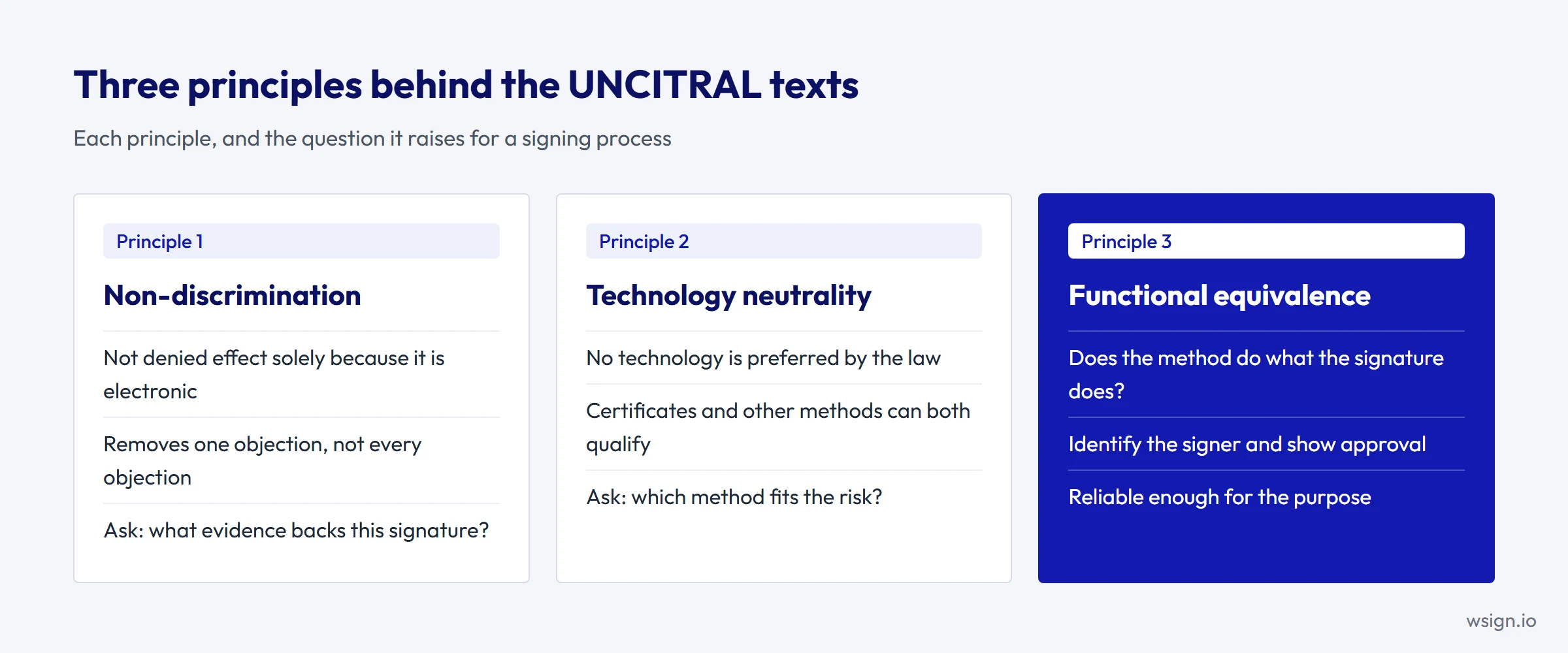
| Principle | What it means | Question for your process |
|---|---|---|
| Non-discrimination | A communication is not denied effect just because it is electronic. | Are we relying only on this, or also on evidence? |
| Technology neutrality | The law does not favour a specific technology. | Which method fits the risk, not the trend? |
| Functional equivalence | An electronic method counts if it performs the function of the paper requirement. | Does our method identify the signer, show approval, and stay reliable? |
Functional equivalence is the one with the most practical bite. It does not ask "is this electronic signature the same as ink?". It asks what a handwritten signature does in this situation, namely identify the person and show they approved the content, and whether the electronic method does the same job reliably enough for the purpose.
Why Gulf and MENA laws look alike
UNCITRAL's status pages list several Gulf states among the jurisdictions whose legislation is based on or influenced by its models. At the time of writing, the page for the Model Law on Electronic Signatures lists the United Arab Emirates (2006), Saudi Arabia (2007), Oman (2008) and Qatar (2010), and the page for the Model Law on Electronic Commerce also lists Jordan (2015) and Bahrain (2018). The status pages change as new information reaches the Secretariat, so check them directly for the current list.
That shared ancestry explains the familiar phrasing: a rule that electronic form alone does not defeat validity, a functional test for signatures, and often a higher tier for signatures backed by certificates from licensed providers. But the details differ. One law may list excluded transactions that another does not; one may define what a "protected" or "certified" signature requires in technical terms; another may leave more to the courts. Our country guides for Saudi Arabia and the UAE and GCC look at those national texts in their own right.
What this means when you sign across borders
For a business that signs with counterparties in several of these countries, the shared model gives a common baseline, and the national texts supply the exceptions. A sensible approach:
- Design to the functional test. Make sure every signature identifies the signer, shows clear approval of a fixed document, and is backed by evidence of reliability: verification steps, timestamps and a document fingerprint.
- Check the national exclusions. Each enacting law may carve out documents such as family-law matters or real-property transfers. Our sibling article on documents excluded from e-signature explains the usual categories.
- Know when a certificate-based signature is expected. Some laws give a stronger position to signatures supported by certificates from licensed providers. Where that matters, the signer may need a token issued by such a provider.
- Agree the method in writing. A clause in which the parties accept electronic signing and the chosen method reduces later disputes in every jurisdiction.
For the comparable picture in the United States, which developed its own federal and state model, see our explainer on ESIGN and UETA.
How wsign supports a functional-equivalence approach
wsign is built around the evidence that functional equivalence relies on. Signers can be verified by one-time code or by an external specialised identity provider; where they hold a token certificate from a licensed certification provider, they can sign with it; and every completed document gets a SHA-256 fingerprint, a trusted timestamp and an evidence record that a recipient can check on the verification page. The glossary explains the terms used throughout. Whether a given method satisfies a particular national law remains a question for local counsel.
Frequently asked questions
Is a UNCITRAL model law binding in my country?
No, not by itself. A model law only has effect through national legislation based on it. The Electronic Communications Convention of 2005 is different: as a treaty, it binds the states that are parties to it.
What is functional equivalence in one sentence?
An electronic method satisfies a legal requirement for writing or signature when it performs the same function the paper form performs, with reliability appropriate to the purpose.
Does technology neutrality mean every e-signature is equally strong?
No. It means the law does not prefer one technology. Reliability still matters, and some national laws give a higher status to certificate-based signatures.
Where can I check whether a country has enacted a model law?
UNCITRAL publishes a status page for each text. It is indicative, so confirm with the national legislation itself.
To see how identity checks, fingerprints and timestamps come together in a single evidence record, create a wsign account and send a test document.
This article is general information, not legal advice.