An e-signature service ends up holding some of the most sensitive files a company has: employment contracts with salaries, supplier terms, customer identity checks, board approvals. Yet it is often bought the way a small productivity tool is bought, by whoever needs it first, with security questions asked after the contract is signed.
This article is a working questionnaire for IT, security and procurement teams evaluating an e-signature provider. It is grouped by topic, explains why each question matters, and suggests what kind of answer or evidence to expect. Where a question rests on a legal requirement, the source is linked so you can read the text yourself.
Use it in proportion. A team sending a few internal acknowledgements a month does not need the same depth as a bank sending loan agreements. Decide first how sensitive the documents will be, then pick the sections that match.
Before you send the questionnaire
Three decisions make the exercise faster and the answers more useful.
- Classify the documents. Will they contain personal data, special categories of data, financial terms, or identity document images? The answer decides which sections are mandatory.
- Request proof rather than descriptions. "We take security seriously" is not an answer. A configuration screenshot, a policy extract, an assurance report or a contract clause is.
- Agree who reads the answers. Security reviews the technical sections, legal reviews the processor terms, and the business owner decides whether residual risks are acceptable.
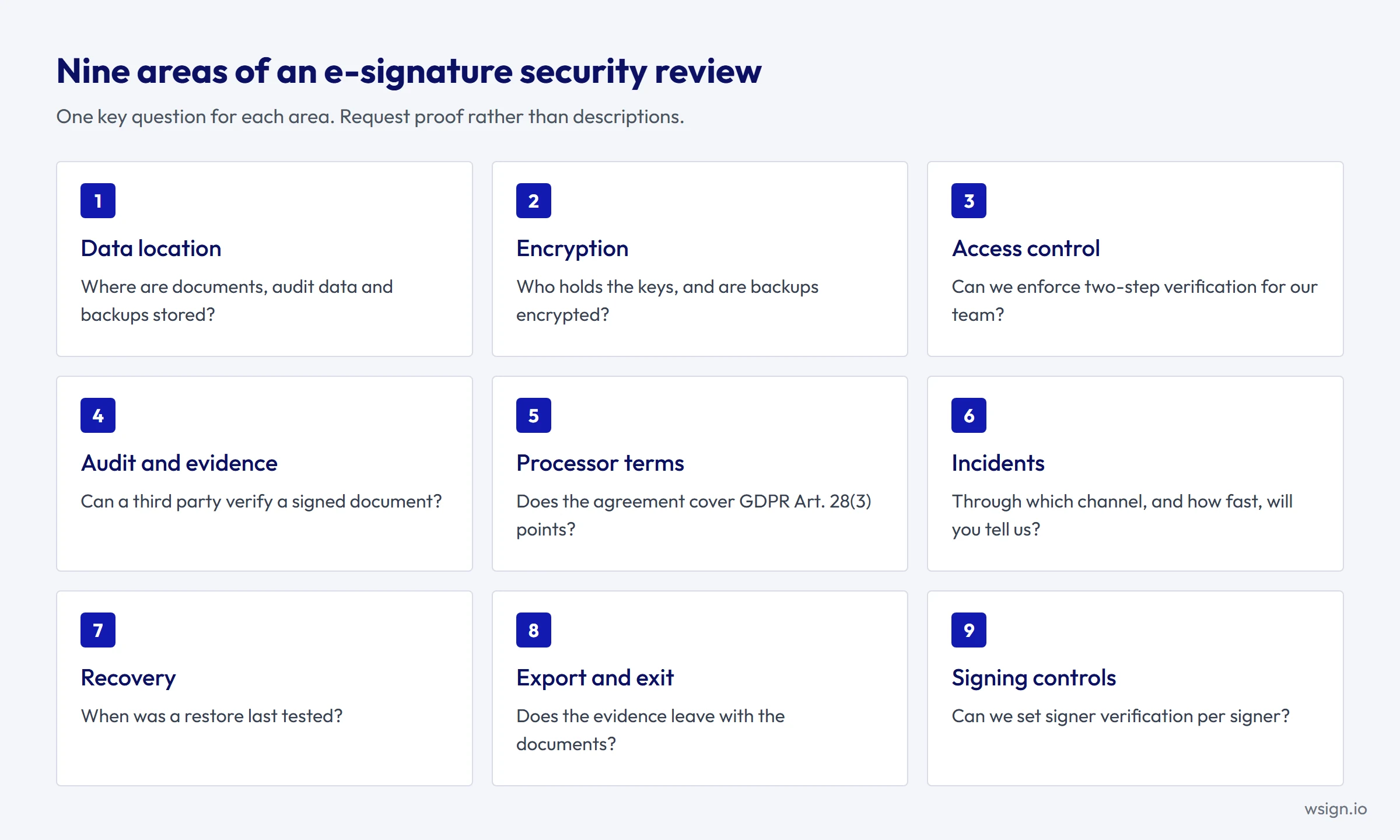
The questionnaire
1. Data location and transfers
- In which countries are documents, audit data and backups stored? Are they the same?
- Which countries can support staff and sub-processors access the data from?
- Can we choose or restrict the storage region?
Why it matters: if the data includes personal data of people in the EU, transfers to other countries are governed by Chapter V of the General Data Protection Regulation (GDPR), Articles 44 to 50. Other countries have their own transfer rules. You need a clear map before legal can assess it.
2. Encryption and key management
- Is data encrypted in transit, and with which protocol versions?
- Is data encrypted at rest, including backups? Who holds the keys, and who can use them?
- How are signing keys and timestamping credentials protected?
Why it matters: GDPR Article 32(1) lists "the pseudonymisation and encryption of personal data" among the measures a controller and processor should consider. Beyond the regulation, the answer tells you whether a database copy or a stolen backup would expose readable contracts.
3. Access control
- Does the service support two-step verification for user accounts, and can we enforce it for our whole team?
- Can we set roles so that some users send, some approve, and some only view?
- How is the vendor's own staff access to customer data granted, limited, logged and reviewed?
- How quickly is access removed when one of their employees leaves?
4. Audit logs and signing evidence
- What does the per-document audit trail record: invitations, opens, authentication method, IP address, timestamps, signature events?
- Is each signed document protected against later change, for example with a cryptographic fingerprint and a trusted timestamp?
- Can a third party verify a signed document without an account?
- Are administrative actions in our account (user changes, settings, exports) logged and visible to us?
Two kinds of log matter here and should not be confused: the evidence that travels with each signed document, and the operational logs that show who did what in your account. Our article on contract audit trails looks at the first in detail.
5. Processor terms
If the provider processes personal data on your behalf, GDPR Article 28 sets out what the contract must contain. Check the data processing agreement against each point:
- Processing only on your documented instructions (Art. 28(3)(a)).
- Confidentiality commitments for people authorised to process the data (28(3)(b)).
- The security measures required by Article 32 (28(3)(c)).
- Sub-processors only with your prior specific or general written authorisation, with notice of changes and a chance to object (28(2) and 28(3)(d)).
- Assistance with data subject requests and with your own obligations under Articles 32 to 36 (28(3)(e) and (f)).
- Deletion or return of all personal data at the end of the service, at your choice (28(3)(g)).
- Information to demonstrate compliance, and allowance for audits and inspections (28(3)(h)).
Article 28(1) also requires a controller to use only processors that give "sufficient guarantees" of appropriate technical and organisational measures. This questionnaire is one way to document that you looked.
6. Incident handling
- How will you tell us about a security incident affecting our data, through which channel, and within what time?
- Who is our contact during an incident, and what information will you provide?
- When did you last test your incident response, and what changed afterwards?
Under GDPR Article 33(2), a processor must notify the controller of a personal data breach "without undue delay" after becoming aware of it. Many buyers also ask for a specific number of hours in the contract, because "without undue delay" is hard to measure in a dispute.
7. Availability and recovery
- How often are backups taken, where are they kept, and when was a restore last tested?
- What happens to documents in the middle of signing if the service is down for a day?
- Is there a public status page or incident history?
GDPR Article 32(1) names "the ability to restore the availability and access to personal data in a timely manner" and "a process for regularly testing, assessing and evaluating" security measures among the measures to consider. A restore test date is a better answer than a backup frequency.
8. Export and exit
- Can we export every signed document together with its audit trail and evidence, in bulk, in open formats?
- After we leave, can recipients and auditors still verify documents we signed through you?
- How long after termination is our data deleted, and will you confirm deletion in writing?
Exit is where many evaluations are thinnest. A signature is only as useful as your ability to prove it later, so make sure the evidence leaves with the documents. Our guide on retention schedules for signed contracts helps you decide how long you will need it.
9. Signing-specific controls
- Which signer authentication options exist: one-time code, identity verification, certificate token? Can we set them per signer?
- How are API keys and webhook endpoints protected, and can keys be scoped and rotated?
- Can documents pass an internal approval step before they are sent?
Reading ISO/IEC 27001 and SOC 2 claims correctly
Vendors often answer a questionnaire by pointing to an assurance report or certificate. Both are useful, and both are easy to misread.
| ISO/IEC 27001 | SOC 2 | |
|---|---|---|
| What it is | An international standard setting requirements for an information security management system | An examination by a certified public accountant of controls at a service organisation, under criteria published by the AICPA |
| What you receive | A certificate from an independent certification body, with a stated scope | A report describing the system and the auditor's opinion; a type 2 report also covers whether controls operated effectively over a period |
| What to check | The scope (does it cover the e-signature service you are buying?), the certification body, and whether that body is accredited | Which trust services categories are covered, the period, the scope, and any exceptions the auditor noted |
ISO/IEC 27001:2022 defines requirements for establishing, implementing, maintaining and continually improving an information security management system. ISO itself does not carry out certification; independent certification bodies do, and ISO's help centre explains how to verify an accredited certification. A certificate whose scope covers only a vendor's head office, or a different product, tells you little about the service you are buying.
SOC reports are issued by CPAs on a service organisation's system-level controls. The AICPA's SOC 2 guide covers controls relevant to security, availability, processing integrity, confidentiality, or privacy. Read the full report, not only the summary letter: the scope and the exceptions section matter most.
Neither one replaces your own questions. An assurance report shows that a vendor's controls were assessed against a framework; it does not show that the vendor's product fits your documents, your countries, or your exit plan.
Answers that should prompt a follow-up
- "All data is encrypted" with no mention of backups, keys or who can decrypt.
- "We never access customer data" alongside a support process that clearly requires it.
- A list of sub-processors that is "available on request" but never arrives.
- Exports limited to PDFs without the audit trail or evidence.
- Incident notification promised "as appropriate."
- Certifications whose scope or issuer cannot be confirmed.
You can send these same questions to wsign. Our trust centre, compliance page and developer security notes describe the controls we have today, such as SHA-256 document fingerprints, trusted timestamps, per-document evidence files, internal review before sending, and two-step verification for accounts. Anything they do not cover, you can ask us directly.
Frequently asked questions
Is a SOC 2 report or ISO/IEC 27001 certificate mandatory for an e-signature vendor?
Not by law in general. Some buyers make one a contractual requirement, especially in regulated sectors. Where a vendor has neither, the questionnaire and supporting evidence carry more weight.
Do we need a data processing agreement if we only send contracts to companies?
Contracts sent to companies still contain names, emails and phone numbers of the people who sign them, which are personal data. If GDPR applies to your processing, Article 28 terms are needed whenever the provider processes that data for you.
How often should we repeat the review?
A common approach is a light review yearly and a full one when the vendor's scope, ownership or sub-processors change, or when you start sending a more sensitive type of document.
Should the questionnaire cover the vendor's API?
Yes, if you integrate. Ask how keys are issued, scoped and revoked, how webhook messages are signed, and whether there is a separate test environment so production data is not used for development.
If you are comparing providers, you can create a wsign account to test the evidence and controls yourself before you send us your questionnaire.
This article is general information, not legal advice.