An Arabic–English contract is two documents pretending to be one. Each sentence exists twice, written by different hands or at different times, and each version will be read by someone who trusts it more than the other. Most of the time the two say the same thing. The trouble starts in the clause where they do not, and nobody noticed until a payment was disputed.
A good bilingual contract plans for that moment. It says which text wins, it keeps defined terms identical in both languages, it lays the versions out so that differences are easy to spot, and it makes sure the parties sign the same combined document rather than one language each.
This guide covers those four pieces in practical terms. It is written for people who prepare Arabic–English agreements in sales, procurement, employment and partnerships, and it applies to most other language pairs as well.
Pick a model before you translate anything
There are three common ways to handle two languages, and the choice shapes everything that follows.
| Model | How it works | Main risk |
|---|---|---|
| One binding language plus a courtesy translation | Only one text is the contract; the other is provided for convenience and says so. | The party reading the translation may not realise it has no legal weight. |
| Bilingual with a prevailing language | Both texts form the contract, and a clause names the one that controls if they differ. | The non-prevailing reader carries the risk of translation errors. |
| Bilingual, both equally authentic | Both texts have the same force and no tie-breaker is named. | A conflict has no built-in answer and becomes an argument about intent. |
The middle model is the usual compromise in commercial agreements. The third is common in treaties, where states negotiate every word, but in a private contract it pushes the question to whoever eventually interprets the agreement. Under the EU's Rome I Regulation, for example, interpretation is governed by the law applicable to the contract (Article 12(1)(a)); a clear language clause tells that court or tribunal which text to start from. Some countries have their own requirements about the language of particular contracts or of documents filed with authorities, so check local rules for your deal.
Write the prevailing-language clause properly
A single sentence saying "the English version prevails" is better than nothing, but a careful clause answers several more questions:
- Scope. Does the rule cover only the main body, or also schedules, annexes, purchase orders and later amendments? Say it covers all of them unless you have a reason not to.
- Notices and correspondence. Which language will formal notices use? If a termination notice can be sent in either language, say so; if not, name the language.
- Documents that exist in one language only. Technical specifications or price lists are often attached in one language. State that they form part of the contract as written.
- Acknowledgement. A short statement that each party has read and understood both versions, or has had the opportunity to obtain a translation, reduces later claims of surprise.
For example, imagine a clause along these lines: "This Agreement is executed in Arabic and English. Both texts form the Agreement. If there is any inconsistency between them, the [chosen] text shall prevail. This clause applies to all schedules and amendments." The bracket is deliberate. Which language should prevail is a commercial and legal decision, often tied to the governing law and the forum where disputes will be heard, and it is worth discussing with counsel rather than defaulting to habit.
Lay the two texts out so differences show
Layout is not cosmetic. It decides whether a reviewer can compare the versions line by line or has to hunt for the matching paragraph twenty pages away.
Side by side
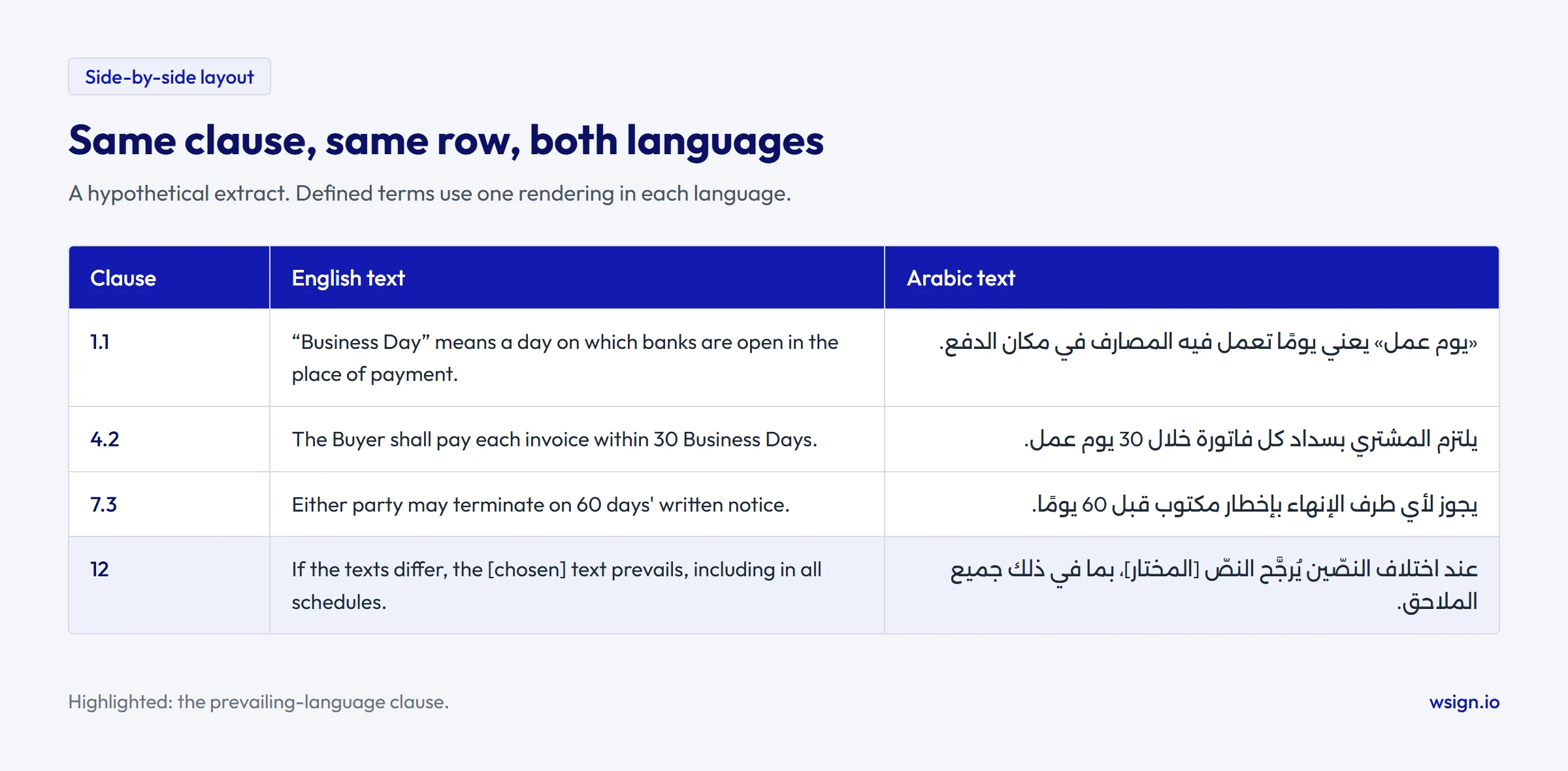
Two columns, Arabic on the right and English on the left, with each clause on the same row. Missing sentences become obvious because one column runs short. This layout suits contracts of moderate length and is easiest to review.
Consecutive versions
The full English text followed by the full Arabic text, or the reverse. It is simpler to produce and reads better on phones, but comparison is harder. If you choose it, keep identical clause numbers and headings so that clause 7.3 in one is clause 7.3 in the other.
Details that break in mixed-direction text
- Clause numbers, amounts and dates can flip order when English fragments sit inside Arabic sentences. Read numbers in the final PDF, not only in the editor.
- Write currency and amounts in one consistent pattern in both versions, for example the figure followed by the currency code.
- Write party names in both scripts once, in the parties clause, and use the defined short name afterwards.
Treat defined terms as a shared vocabulary
Most disagreements between language versions start with defined terms. English contracts mark them with capital letters; Arabic has no capitals, so the signal disappears unless you replace it with quotation marks, bold type or both at the point of definition.
Build a short glossary before translating: each defined term in English, its single Arabic rendering, and the clause where it is defined. Then hold the translator to it. If "Business Day" becomes «يوم عمل» in clause 1, it must not become «يوم العمل الرسمي» in clause 9; a reader could reasonably ask whether two different things are meant. The same applies to obligation words. Decide once how "shall", "may" and "must" are rendered, because the difference between an obligation and a permission is exactly what disputes turn on.
A review process that catches mismatches
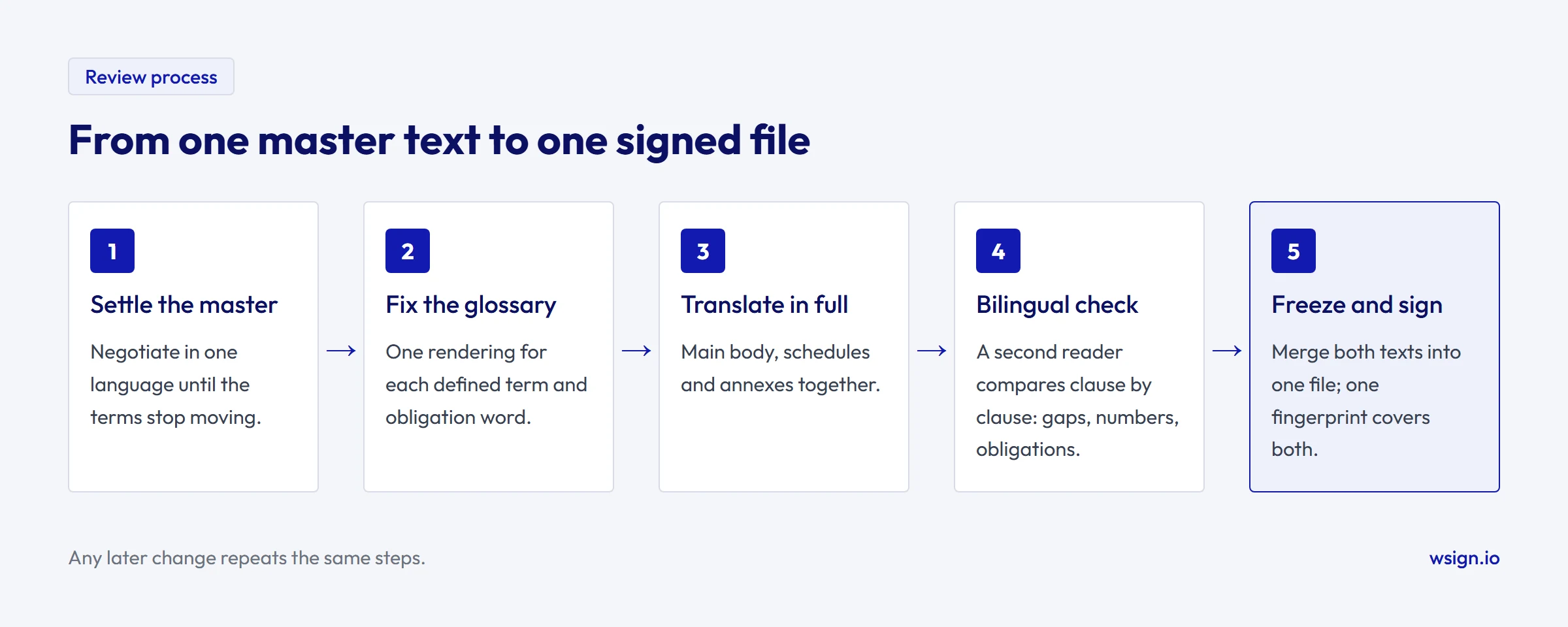
- Settle the master text first. Negotiate in one language until the commercial terms are stable. Translating a moving draft multiplies the chances of a mismatch.
- Fix the glossary. Agree the defined terms and key obligation words in both languages.
- Translate the whole document, schedules included. A professional legal translator is worth the cost for anything with real money at stake.
- Run an independent bilingual check. A second person who reads both languages compares clause by clause, looking for omissions, numbers and obligation words rather than style.
- Freeze both versions together. Once approved, combine them into one file and stop editing. Any later change goes through the same steps.
Teams that already route contracts through an internal approval step can add the bilingual check as one of its stages; wsign's review workflow keeps a record of who approved which version before it was sent.
Sign one file that contains both languages
The cleanest approach is to sign a single document that holds both texts. If each party signs only "their" language, you have two signed documents and an open question about whether each party agreed to the other text.
You can draft the combined text in wsign's contract editor or import a finished PDF and place signature fields on the last page. Because the document's SHA-256 fingerprint is computed over the entire file, it covers both language versions at once: if anyone later alters a word in either column, the fingerprint no longer matches. Before sending, a quick pass through a pre-send checklist catches the usual slips, such as an annex attached in one language only.
When the counterparty is in another country, the language question sits alongside governing law, forum and deadlines; our guide to cross-border contract signing covers those together.
Frequently asked questions
Should Arabic or English prevail?
There is no universal answer. Parties often choose the language of the governing law or of the forum, and some jurisdictions have rules on contract language for certain documents. Decide it deliberately and confirm with counsel.
Is a courtesy translation enough for employees or consumers?
It may not be. Protective rules in some countries look at whether the weaker party could understand what they signed. Take local advice before relying on a translation marked as non-binding.
Do amendments need to be bilingual too?
If the original contract is bilingual, keep amendments in the same structure and say that the prevailing-language clause applies to them, otherwise the rule may not reach the most recent changes.
Can I sign a PDF where the two versions are in separate files?
You can, but merging them into one file before signing is safer, so a single signature and one fingerprint cover both texts.
wsign lets you prepare a bilingual contract in the editor or upload it as a PDF, then send it for signature as one document. Create an account to try it with your next agreement.
This article is general information, not legal advice.