Signing a contract with someone in another country looks, on screen, exactly like signing with a neighbour: a link arrives, the signer reviews the document, adds a signature and confirms. The differences sit underneath. Two legal systems may each claim the contract, the parties may read different languages, a deadline written as "Friday" may already have passed for one of them, and an identity check designed for one country's documents may not recognise the other's.
None of these problems is solved by the signing tool alone. They are solved by decisions taken before the document is sent, and by evidence captured while it is signed. This guide walks through those decisions in the order they usually come up, using the EU Rome I Regulation as a worked example of how a choice-of-law rule operates.
The aim is practical: a contract that both sides can rely on, a signing process the foreign party can actually complete, and a record that still makes sense if a dispute reaches a court or tribunal in either country.
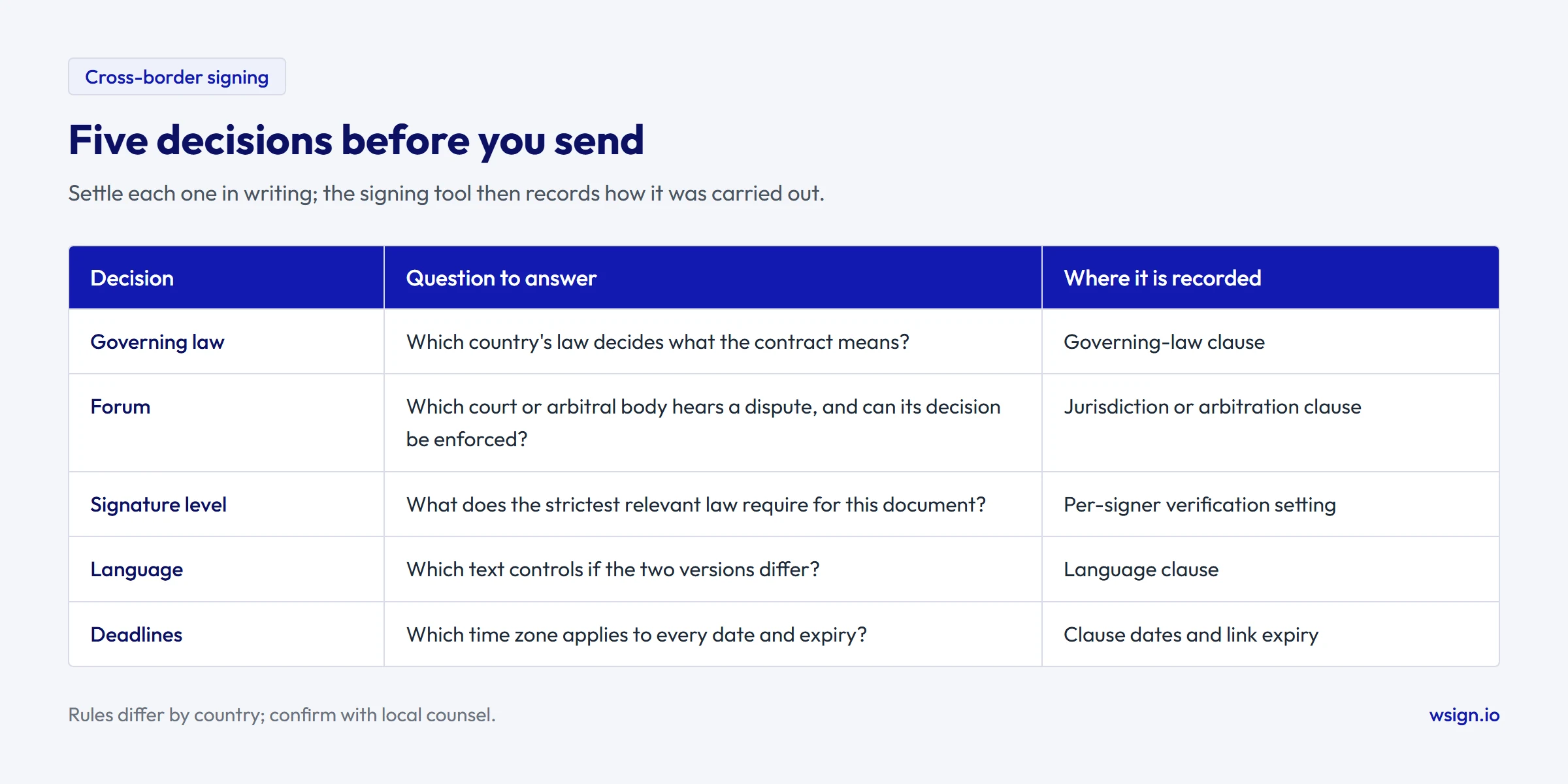
Start with the law that governs the contract
Before thinking about signature methods, settle which country's law will govern the agreement. That law decides how the contract is interpreted, what happens on breach, and often how long claims can be brought. If you leave the question open, a court will answer it for you using its own conflict-of-laws rules, and the answer may surprise both parties.
How Rome I answers the question in the EU
Courts in EU Member States apply Regulation (EC) No 593/2008 (Rome I) to contractual obligations in civil and commercial matters, for contracts concluded after 17 December 2009 (Article 28). A few of its rules show why an express clause matters:
- Party choice comes first. Article 3(1) states that a contract is governed by the law chosen by the parties, and that the choice must be made expressly or be clearly demonstrated by the terms or circumstances. The parties may choose a law for the whole contract or for part of it.
- Defaults apply when there is no choice. Under Article 4(1), a sale of goods is governed by the law of the seller's habitual residence and a contract for services by the law of the service provider's habitual residence. Where no listed category fits, Article 4(2) points to the habitual residence of the party performing the characteristic obligation.
- The chosen law need not be European. Article 2 provides that the law designated by the Regulation applies whether or not it is the law of a Member State.
- Some protections cannot be contracted away. Article 6(2) prevents a choice of law from depriving a consumer of protection given by the law of their habitual residence, and Article 9 preserves "overriding mandatory provisions" that a country regards as crucial to its public interests.
Rome I is one regime among many. A court in the Gulf, the United States or Asia applies its own rules, which may treat an express choice differently. The lesson travels well, though: write the choice down, in plain words, rather than hoping it can be inferred.
Formal validity is a separate question
Whether a contract is valid in form can be governed by a different test from what it means. Rome I Article 11(1) treats a contract between parties in the same country as formally valid if it meets the formal requirements of the governing law or of the country where it was concluded; Article 11(2) gives wider alternatives for parties in different countries. This is the point where electronic signatures enter the picture: if either relevant law requires a particular form for a type of document, an ordinary electronic signature may not be enough. The rules on which documents are excluded or treated specially vary by country, as our guide to documents excluded from e-signature explains. For anything unusual, ask counsel in each country involved.
Choose where disputes will be heard
Governing law and forum are different clauses. Rome I itself does not cover them together: Article 1(2)(e) excludes arbitration agreements and agreements on the choice of court from its scope. So a contract that names English law but says nothing about which courts or which arbitral body will hear a claim has only done half the work.
When the parties sit in different countries, think about where a judgment or award would need to be enforced. A clause that sends disputes to a forum whose decisions are hard to enforce against the other party's assets is weak protection, however carefully the rest of the contract is drafted. This is a legal judgment that depends on the countries involved, so it is worth a short conversation with a lawyer before the contract wording is finalised.
Make sure the signing method is accepted on both sides
Most legal systems now accept electronic signatures for ordinary commercial contracts, but they describe the levels differently. An EU counterparty may ask whether a signature is "advanced" or "qualified" under eIDAS; a US party may only need a record of intent and consent under ESIGN. The two questions to ask are simple: what level does the strictest relevant law require for this document, and what evidence will the other side expect to see?
In practice, cross-border deals tend to need stronger signer authentication than domestic ones, because the parties have no shared offline way to confirm who is who. wsign lets the sender raise the level per signer: a one-time verification code by email or WhatsApp, identity verification by an external specialised provider, or a certificate token issued by a licensed certification provider for signers who have one. Match the level to the risk of the document rather than applying the heaviest option to everything.
Identity when names and documents differ
Cross-border identity has a few traps that domestic signing rarely meets:
- Names in more than one script. An Arabic name transliterated into Latin letters can be spelled several ways. Write the signer's legal name exactly as it appears on the identity document they will use, and keep the transliteration consistent across the contract, the signer field and any annex.
- Company signatories. A person signing for a foreign company needs authority under that company's own law and constitution. Ask for evidence of authority before signing, not after a dispute starts.
- Phone numbers and channels. If you send verification codes by WhatsApp or SMS, store numbers in full international format with the country code. A domestic-format number is the most common reason a foreign signer never receives the code.
Deadlines, time zones and the date of signature
"Sign by Thursday" means different moments in Riyadh, London and San Francisco. Express deadlines with a time and a time zone, or in UTC, and set the signing link's expiry with the furthest signer in mind. Where several parties sign in sequence, remember that each step may lose most of a working day to the time difference; a signing order that works domestically in a day may need three across continents.
The contract's effective date also deserves a clause of its own. If the agreement takes effect "on signature", say whether that means the last signature. The signing record answers the factual question: wsign's audit trail stores each event with its time, and a trusted timestamp fixes when the final document existed in its signed form, which is far more persuasive than a date typed into the document by hand.
Language and the version that controls
If the parties work in different languages, decide early whether the contract will be monolingual with a courtesy translation or genuinely bilingual. Under Rome I Article 12(1)(a), interpretation is a matter for the governing law, which makes a clear language clause even more useful: it tells whichever court applies that law which text to read. Our separate guide on bilingual contracts and the prevailing language covers layout, defined terms and review.
Keep evidence both sides can read
A dispute may be heard in either party's country, so the evidence should not depend on access to your systems. At completion, make sure each party receives the final signed file and its evidence record, and that the document can be checked independently. wsign provides an evidence file for each signed document and a public verification page where anyone holding the verification number can confirm the document's fingerprint. Store your own copy under the retention period that the longest relevant limitation rule requires.
Frequently asked questions
Does the governing law have to be the law of one of the parties' countries?
Not under Rome I, which allows the parties to choose and applies the chosen law even if it is not that of a Member State. Other legal systems may set limits, and mandatory local rules can still apply, so check with counsel when choosing a neutral law.
Is a choice-of-court clause covered by the governing-law clause?
No. They are separate decisions, and Rome I expressly excludes choice-of-court and arbitration agreements from its scope. Draft both.
Which time zone should the contract use?
Any, as long as it is stated. UTC avoids daylight-saving surprises; otherwise name the city or zone next to every deadline.
Can each party sign with a different verification method?
Yes. Authentication can be set per signer, so a party who holds a certificate token can use it while another verifies with a one-time code or an identity check.
If you sign with partners abroad, you can set signer order, verification level and expiry for each party in wsign. Create an account and send your first cross-border agreement.
This article is general information, not legal advice.