Freelancers and small agencies rarely lose money because a client refuses to pay outright. They lose it in the grey areas: a quick extra page that turned into a week, a "final" round of revisions that was the fifth, a delivery the client never formally accepted and then disputed two months later. Each of those situations starts with an informal yes that nobody wrote down.
The fix is not a longer contract. It is a short signed record at each point where the project changes direction. With electronic signing, each record takes a minute to send and a minute to sign, so there is no longer a good reason to rely on a chat message.
This article follows a project from proposal to final sign-off and shows which document belongs at each stage, what it should contain, and how to keep the client's signatures consistent with what you actually deliver.
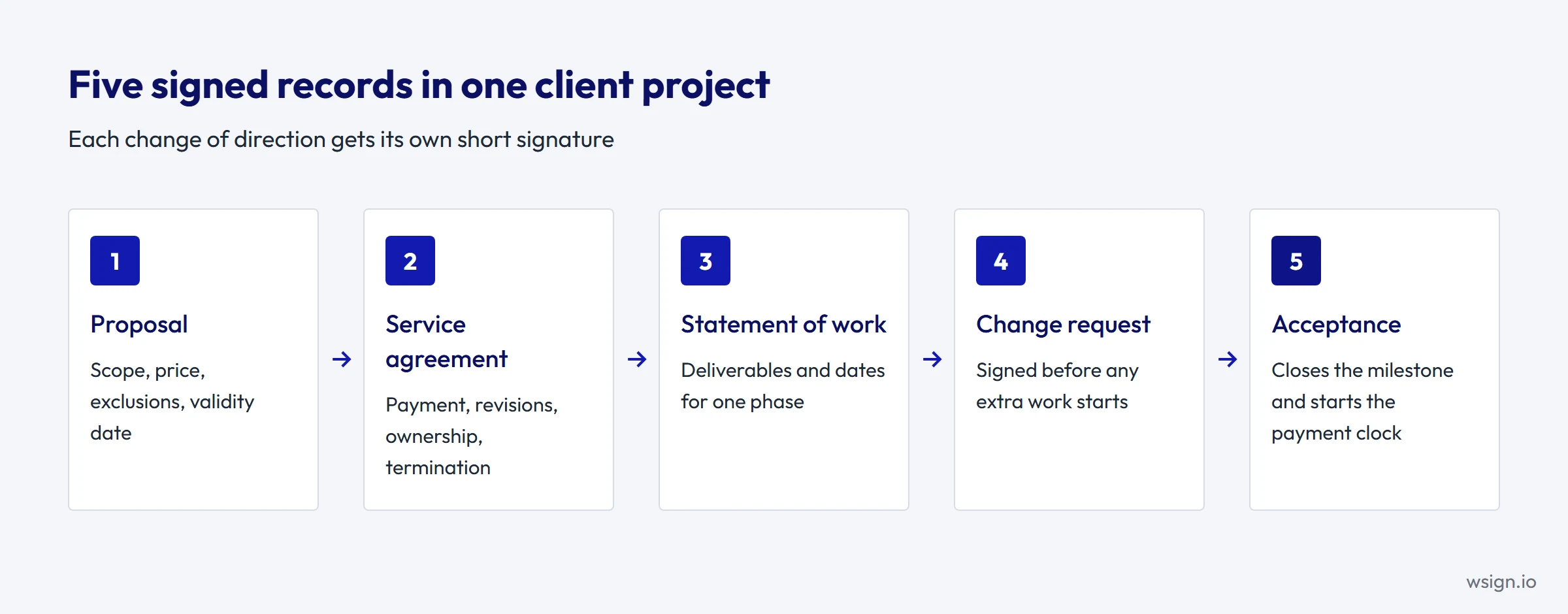
The five documents of a client project
| Stage | Document | What it settles |
|---|---|---|
| 1. Pitch | Proposal or quotation with an acceptance field | Scope, price and validity period the client agreed to |
| 2. Start | Service agreement, with a confidentiality clause or separate NDA | The rules of the relationship: payment, revisions, ownership, termination |
| 3. Each phase | Statement of work | Deliverables, dates and price for that phase |
| 4. Any change | Change request | The new scope, its cost and its effect on the timeline |
| 5. Delivery | Acceptance certificate | That the client received and accepted a specific deliverable |
Small jobs can merge stages 1 to 3 into one signed proposal. What should never be merged away is the change request and the acceptance certificate, because those are the two documents that protect your invoice.
Proposal: turn the client's yes into a signature
A proposal sent as an attachment invites a reply such as "looks good, let's go", which tells you little about what exactly was approved. Send the proposal for signature instead, with one acceptance field at the end. Three details make it work:
- A validity date. Prices change. Set the signing request to expire when the offer does, so an old quote cannot be accepted six months later at last year's rate.
- Exclusions in writing. A short "not included" list prevents more disputes than a long "included" list.
- Assumptions behind the price, such as the number of pages, rounds of revisions or languages. When an assumption breaks, you have a clear reason for a change request.
The service agreement: rules for the whole relationship
The agreement is the document you reuse with each new client. Draft it once in the contract editor with fields for the client's details, then adjust per client. Most freelance disputes trace back to a handful of clauses, so make sure these are present and specific:
- Payment linked to acceptance. State that each milestone invoice is due a set number of days after acceptance of that milestone.
- Revisions. How many rounds are included, and that further rounds are billed or handled through a change request.
- Acceptance procedure. How the client accepts a deliverable, how long they have to review it, and what happens if they say nothing. Whether a "deemed acceptance" clause is enforceable depends on the governing law, so check it with counsel if large sums are involved.
- Ownership of work. When rights in the deliverables pass to the client, for example on full payment, and what you may keep for your portfolio.
- Confidentiality and termination. What each side must keep confidential, and how either side can end the engagement and settle work in progress.
On the client's side, check that the person signing can actually commit the company, particularly with larger organisations where a project manager may not hold that authority. The article on who can sign for a company explains what to ask for.
Change requests: the document that protects your margin
Scope creep is rarely dishonest. A client asks for something reasonable, you agree in a call, and the cost never reaches the invoice. A signed change request turns that conversation into a priced decision before the work starts. Keep it to one page:
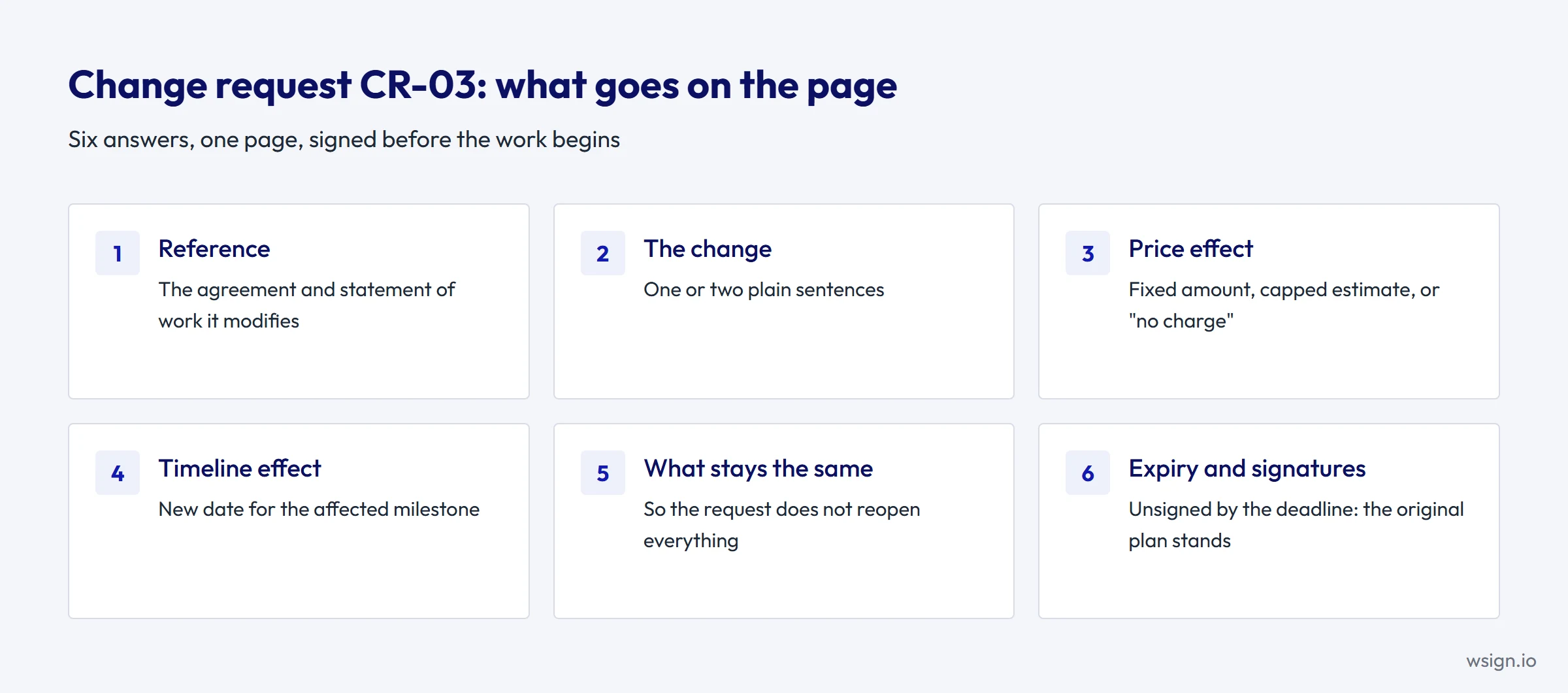
- Reference to the agreement and statement of work it modifies, with a sequential number such as CR-03.
- The change in one or two plain sentences.
- Price effect: a fixed amount, an hourly estimate with a cap, or "no charge" stated explicitly.
- Timeline effect: the new delivery date for the affected milestone.
- What does not change, so the client cannot later read the request as reopening everything.
- Expiry: if the client does not sign within a few days, the original plan stands.
Make one rule non-negotiable for yourself: no extra work starts until the change request is signed. Because the client signs from a phone in a couple of minutes, the rule rarely slows the project, and it removes the awkward conversation at invoice time. Construction firms run the same discipline under a different name; the article on change orders in construction shows how it works with several parties on site.
Acceptance and final sign-off
An acceptance certificate is a short document that names the deliverable, its version or delivery date, and a statement that the client accepts it, optionally with a list of minor items to fix that do not block acceptance. It does three jobs at once: it closes the milestone, it starts the payment clock under your agreement, and it fixes the version that the client approved.
Send it the day you deliver, not at the end of the month. Use reminders and a reasonable expiry so it does not sit unread. When the client signs, quote the document's verification number on the invoice. If the invoice is ever questioned, anyone can confirm the acceptance on the public verification page without you having to forward old emails.
Agencies and subcontractors: keep the chain aligned
Agencies sit in the middle of two sets of documents: the client's agreement above and subcontractors' agreements below. Keep them back to back:
- When a client signs a change request, issue the matching change to the affected subcontractor before they start the extra work.
- Send subcontractors your confidentiality terms before sharing client material, not after.
- Use an internal review workflow so a project manager cannot promise a client something that finance has not priced.
Where several people must sign in sequence, such as account manager, client sponsor and client finance, a fixed signing order keeps each signature in the right place.
Keeping the paper trail useful
A signed document helps only if you can find it quickly. Keep one folder per client containing the agreement, numbered change requests and acceptance certificates in order. Each signed file comes with an evidence record showing who signed, when, and how they were verified. That is usually enough to settle a disagreement with a reasonable client long before it becomes a legal matter. For mistakes to avoid at the sending stage, see common contract signing mistakes.
Frequently asked questions
Is a signed proposal enough, or do I need a full agreement?
For a small, one-off job, a signed proposal with clear scope, price, payment terms and revisions can be enough. For ongoing or larger work, a separate agreement saves you from renegotiating the same terms with every new phase.
The client approved a change by chat. Is that binding?
It may be, depending on the law that applies and on what was said. But a chat message is hard to tie to a specific price and date. A signed change request removes the doubt, so send one even after a verbal yes.
Who should sign first, me or the client?
Either works. Signing first yourself shows the client the final version is settled and they only need to countersign. If you prefer not to be bound until the client commits, let the client sign first and countersign afterwards.
What if a client works in another country?
Include a clause on governing law and on how disputes are resolved, and expect electronic signature rules to differ between countries. For high-value work, ask a lawyer in the relevant country to review the agreement.
Draft your agreement once and send each change request in a minute: create a wsign account.
This article is general information, not legal advice.