Every signing request carries an unspoken question: how sure do you need to be that the person who signed is the person you meant? For a holiday-rota acknowledgement, a click on an email link is plenty. For a personal guarantee on a large loan, the same click would leave you exposed if the signer later says "that wasn't me."
Choosing the level of signer authentication is a trade-off. Set it too low and you weaken your evidence. Set it too high and signers abandon the process, costs rise, and simple documents take days. The right answer depends on the document, not on a company-wide default.
This article gives you a decision matrix for four common levels: an email link, a one-time code by email or WhatsApp, identity verification, and a certificate token. It borrows its vocabulary from the US National Institute of Standards and Technology (NIST) digital identity guidelines, which are a useful reference even outside US government systems.
Two different questions: who is it, and is it them again?
People often say "verify the signer" as if it were one check. It is really two.
- Identity proofing answers "who is this person in the real world?" It links a person to evidence such as an identity document.
- Authentication answers "is the person at the keyboard the same one we invited?" It relies on something the person controls, such as an inbox, a phone, or a cryptographic key.
NIST SP 800-63-4, which supersedes SP 800-63-3, keeps these apart. It defines Identity Assurance Levels (IAL) for proofing, Authenticator Assurance Levels (AAL) for authentication, and Federation Assurance Levels for assertions passed between systems. In outline:
| Level | What NIST SP 800-63-4 describes (section 3.3.2, paraphrased) |
|---|---|
| IAL1 | Supports the real-world existence of the claimed identity, with core attributes validated against authoritative or credible sources |
| IAL2 | Adds more evidence and a more rigorous process for validating evidence and verifying the identity |
| IAL3 | A trained representative interacts with the applicant in an attended, on-site session and collects at least one biometric |
| AAL1 | Basic confidence that the claimant controls an authenticator bound to the account |
| AAL2 | High confidence; two distinct authentication factors and approved cryptography |
| AAL3 | Very high confidence; proof of possession of a key through a cryptographic protocol, using a phishing-resistant authenticator with a non-exportable private key |
The point to borrow is the method rather than the labels. NIST asks agencies to assess the impact of getting identity wrong and then select levels in proportion, through what it calls a digital identity risk management process (section 3). A business signing contracts can do the same thing with far less ceremony. The NIST levels are written for US federal systems and are not a legal test for private contracts; use them as a vocabulary, not as a compliance claim.
The four levels in practice
1. Email link
The signer receives a unique link and signs. This shows that someone with access to that inbox opened the link at a recorded time. It does not show who that someone was, and inboxes are shared, forwarded and delegated. It suits low-stakes internal documents where the signer is already known and a mistaken signature would be easy to correct.
2. One-time code by email or WhatsApp
Before signing, the signer enters a fresh code sent to their email address or phone. This ties the signing session to control of that channel at that moment and leaves a clear entry in the audit trail. Two cautions from NIST's authentication volume, SP 800-63B-4, are worth knowing. It does not accept email as an out-of-band authenticator within its framework (section 3.1.3.1), and it states that one-time code and out-of-band authenticators are not phishing-resistant, because the code typed by hand is not bound to the specific session (section 3.2.5). In plain terms, a code raises the bar against casual misuse, but it is evidence of channel control, not of identity. We explain the mechanics in our earlier piece on one-time code verification.
3. Identity verification
The signer photographs an identity document and completes a face check with a specialised provider, and the result is attached to the signing record. This is identity proofing: it connects the signature to a named person with documentary evidence, which is the main thing an email or code cannot do. It adds a few minutes and a per-check cost, so it belongs where a wrong signer would be expensive or where you have never met the counterparty. Our article on electronic identity verification covers how such checks work.
4. Certificate token
The signer uses a certificate held on a hardware token, issued by a licensed certification provider that proofed their identity before issuing it. Signing requires the token and its PIN, and the result is a cryptographic signature that a PDF reader can validate against the provider's chain. Of the four, this is the closest in spirit to NIST's top authenticator level, because it relies on a key that stays on hardware, though whether a particular token meets any formal level depends on its specification. It also carries the most friction: the signer must already hold a token. See how certificate chains and revocation work for what a token signature proves.
The decision matrix
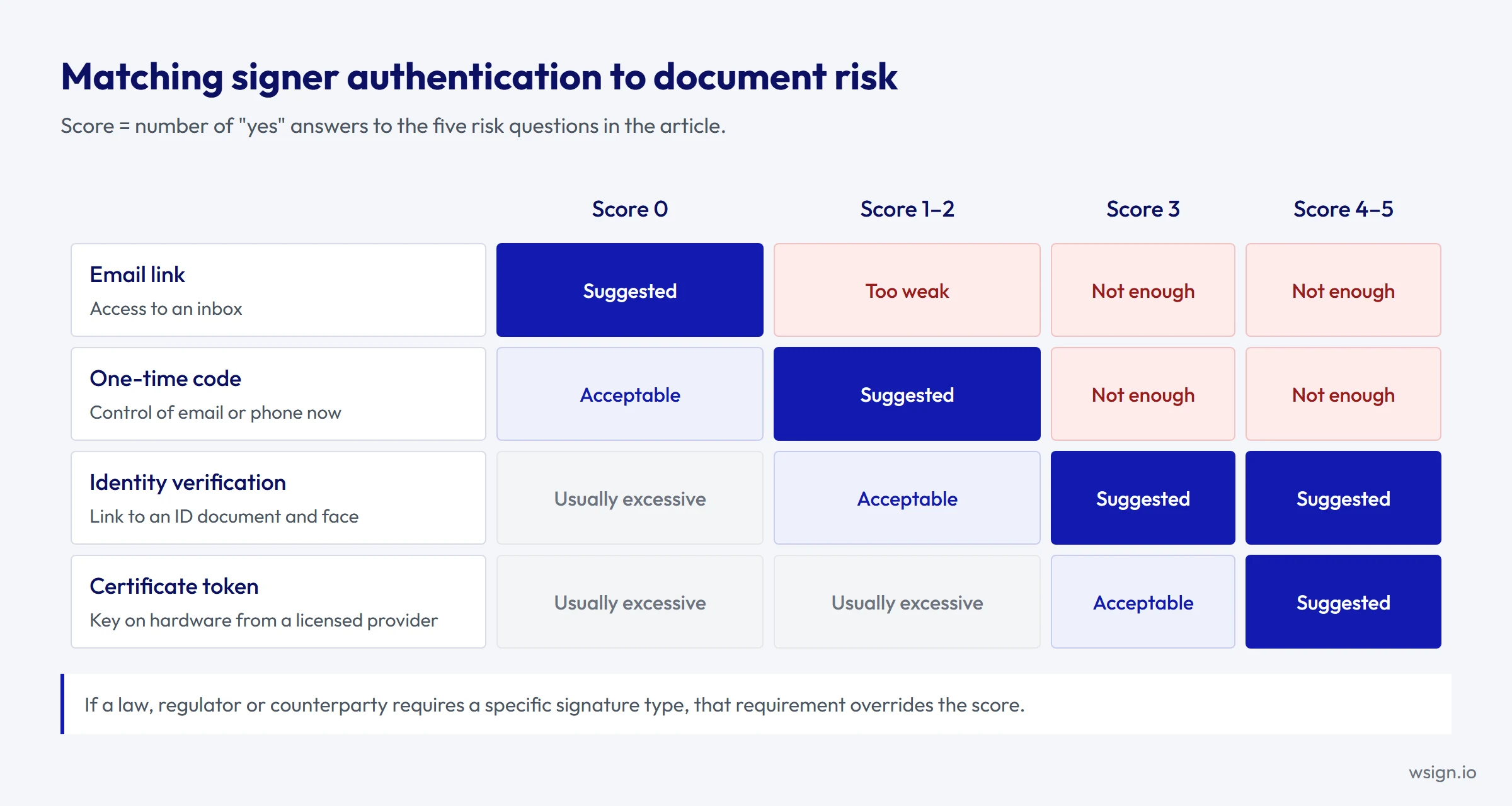
Score each document on five questions. Count one point for every "yes".
- Would a disputed signature cost more than you could comfortably write off?
- Is the obligation hard to reverse once performed (money released, keys handed over, data shared)?
- Have you never dealt with this signer through another verified channel?
- Does the signer gain something by later denying they signed?
- Does a law, regulator or the counterparty require a stronger form of signature for this document type?
| Score | Suggested level | Hypothetical example |
|---|---|---|
| 0 | Email link | An existing employee acknowledging an updated office-equipment policy |
| 1–2 | One-time code by email or WhatsApp | A non-disclosure agreement with a supplier you already work with |
| 3 | One-time code plus identity verification | An employment contract for a remote hire you have only met by video |
| 4–5, or question 5 is "yes" | Identity verification or certificate token, after checking what the rule requires | A personal guarantee from a first-time borrower, or a filing where a specific signature type is mandated |
Treat question 5 as an override. If a rule requires a particular signature type, no score lowers it, and the right level is whatever that rule requires. Rules differ by country and document type, so confirm with local counsel when in doubt.
Different signers, different levels
A single document does not need one level for everyone. Consider a hypothetical sales agreement with three signers: your sales manager, your finance director, and a new customer's managing director. Your own staff already signed in to your systems and can sign with a code. The customer, whom you have never met, can be asked for identity verification. Setting levels per signer keeps friction where the risk actually is. With multiple signers and a signing order, you can also make sure internal approvers sign before the request reaches the external party.
The hidden cost of too much verification
Higher levels are not free. Each extra step is a point where a signer on a phone, in a hurry, or without the right document may give up. Identity checks cost money per attempt, and tokens exclude anyone who does not already have one. If a document scores 0 or 1, asking for a passport scan sends the wrong signal and slows the deal. Our guide on reducing signer drop-off looks at that side of the balance.
Whatever level you choose, record it. The audit trail should show which method each signer used, when, and from where, so that the strength of the evidence is visible to anyone who later reads the file. In wsign, each method, from the one-time code to identity verification and the certificate token, is written into the document's audit trail and evidence file.
Frequently asked questions
Is a one-time code legally enough?
There is no single answer: it depends on the law that governs the document and on the document type. A code combined with a detailed audit trail is a common approach for routine agreements, while some document types and jurisdictions require more. Check the rule for the document, and ask local counsel when the stakes are high.
Should I use identity verification for every contract to be safe?
Usually not. It adds cost and friction and can deter signers on routine documents. Use the scoring questions and reserve it for documents where a wrong signer would really hurt.
Can the signer choose their own level?
The sender should set the minimum, because the sender carries the risk of relying on the signature. Letting a signer choose a higher level, such as a token instead of a code, is fine; letting them choose a lower one defeats the purpose.
What if a signer cannot complete identity verification?
Have a fallback agreed in advance, such as a video call with a manager followed by a code-based signature, and record the reason in the file. Do not silently drop to a lower level.
You can set the verification level per signer when you send a document from a wsign account, and the chosen method appears in the evidence file afterwards.
This article is general information, not legal advice.